


 Part of our dental marketing services
What dental SEO actually is
There is a dentist in your town who is not a better dentist than you.
He has the same degree, the same chair time, the same cavity detection rate, and probably worse coffee in the waiting room. But when somebody two blocks from your office cracks a molar on a popcorn kernel at nine on a Tuesday night and reaches for their phone, they find him.
Not you.
That is not a clinical problem and it is not a reputation problem. It is a search problem, and search problems have solutions that are boring, specific, and entirely fixable if somebody is willing to do the actual work instead of selling you a package.
This page is the whole thing. What dental SEO is, what it is worth, which searches are actually winnable, what it costs, how long it takes, and how to tell whether the person pitching you knows anything at all.

Dental SEO is the work of making a dental practice the obvious answer when somebody nearby searches for what that practice does.
That is the whole definition and everything else is detail. It splits into three buckets that all have to work at once, and a practice that nails two of the three usually sits on page two wondering what went wrong.
There is the map pack, which is the boxed set of three local businesses Google drops above everything else with a little map beside it. There is the organic list underneath it, the blue links, which is where your service pages and your written content live or die.
And there is the growing pile of AI-generated answers that now sit above both of them and quietly decide whether anybody scrolls at all.
Most of what gets sold as dental SEO is a monthly report about the third bucket while nothing happens in the first two.
Dental SEO versus dental ads
Google Ads works the way renting works. You pay, you appear, and the second the card declines you vanish like you were never there.
SEO works the way owning works. It costs more up front in effort and it takes longer to move in, but the position you build stays yours through months where you spend nothing, and it appreciates while you sleep.
The honest answer for most practices is both, at different weights, at different times. A brand new practice with no history and an empty schedule should absolutely be buying clicks while the organic work compounds underneath it, and a fifteen-year practice that already owns its map pack is usually lighting money on fire in the ad auction.
Anybody who tells you it is one or the other is selling the one they know how to do.
Why dental is harder than most local search
Dentistry has a density problem that a roofing company does not have.
In a town of forty thousand people there might be four roofers and twenty-two dental practices, and all twenty-two of them are chasing the same handful of high-intent searches inside the same six-mile radius.
Add the corporate groups – Aspen Dental, Heartland, the private-equity roll-ups buying up practices two towns over – and you are competing against marketing departments, not against Dr. Reynolds down the street.
Those groups have real budgets and mediocre execution, which is the exact gap a well-built independent practice can walk through.
Why your practice is invisible right now
Nobody wakes up and decides to be invisible. Practices get there by doing normal, reasonable things in the wrong order over about six years.
The site was built once, by a cousin or a template company or a dental-specific vendor with a proprietary editor, and it has not been touched since except to swap a staff photo. It has a home page, an about page, a contact page, and a single page called Services that lists nineteen procedures in a bulleted column.

That is the problem in one sentence – nineteen procedures on one page tells Google that this practice is vaguely about dentistry, and Google has no reason to show a vague page to somebody with a specific and painful question.
The three symptoms
You rank for your own practice name and nothing else. Somebody who already knows you can find you, which is the search equivalent of a restaurant whose only customers are relatives.
You show up in the map pack sometimes, from some parts of town, on some devices. Map pack visibility is geographic and it drops off hard past a couple of miles; a practice can look fine from the office parking lot and be entirely absent from the neighborhood it wants to grow into.
Your competitors have pages you do not have. Not better pages – pages.
They have a page about implants and you have a bullet point about implants, and that is the entire difference in the outcome.
What a new patient is actually worth
This is the number that makes the rest of the page make sense, and almost nobody in this industry will put it on a page because it invites the follow-up question about what they charge.
A general dentistry patient in a typical practice runs somewhere around eight hundred dollars a year in production once you average across cleanings, the occasional filling, x-rays, and the crown that shows up every few years. Practice management benchmarks vary by market and by how much of your schedule is insurance-driven, so pull your own number rather than trusting mine.
Average patient tenure in a stable practice runs about a decade.
I am deliberately not doing the multiplication for you. Do it on your own numbers, then look at what you spend on marketing in a year, and then look at how many new patients that spend actually produced.
Cost per click versus cost per patient
Here is a number I can give you exactly, because I pulled it this morning.
The phrase “SEO for dentists” carries a cost per click of thirty dollars in the United States. Thirty dollars for one click from one dentist who might be researching, might be a competitor, and is definitely not committing to anything.
That is what the agencies bidding for your attention are willing to pay just to get you onto a landing page. Sit with what that implies about the margins in dental marketing, and then ask why so much of what gets delivered is a PDF.
Stop fighting for “dentist near me”
This is the part of the page that disagrees with almost every other page you will read on this subject, so let me put the numbers down before the argument.
“Dentist near me” gets 752,000 searches a month in the United States. It carries a keyword difficulty of 62, which in practical terms means the results are locked up by directories, insurance carriers, Yelp, and the corporate groups, and a single independent practice is not dislodging them.
Now look at the searches nobody is fighting for.
The searches nobody is fighting for
| Search | US volume/mo | Difficulty |
|---|---|---|
| dentist near me | 752,000 | 62 |
| pediatric dentist near me | 78,000 | 4 |
| dental implants near me | 72,000 | 37 |
| emergency dentist near me | 57,000 | 0 |
| teeth whitening near me | 56,000 | 0 |
| cosmetic dentist near me | 39,000 | 62 |
| invisalign near me | 24,000 | 3 |
| root canal near me | 4,900 | 0 |
| Three of those are at zero difficulty, and they are the searches attached to people who are in pain, embarrassed, or ready to spend. | ||
Three of those are at zero difficulty. Zero.
Emergency dentist, teeth whitening, and root canal are wide open at the national level and they are the searches attached to people who are in pain, embarrassed, or ready to spend.
One honest caveat, because the number will get quoted at you wrong. These are national figures aggregated across every “near me” search in the country, and your local slice is a fraction of that.
The ratios are what matter, not the totals, and the ratios say the same thing everywhere I have checked them.
The procedure page is the money page
A practice with one Services page is competing in the hardest search it could possibly have chosen and skipping every easy one.
The fix is not clever – it is a real page for emergency dentistry, a real page for implants, a real page for Invisalign, a real page for whitening, each one written like somebody with that specific problem is reading it, each one answering what it costs and what it feels like and how long it takes and whether insurance touches it.
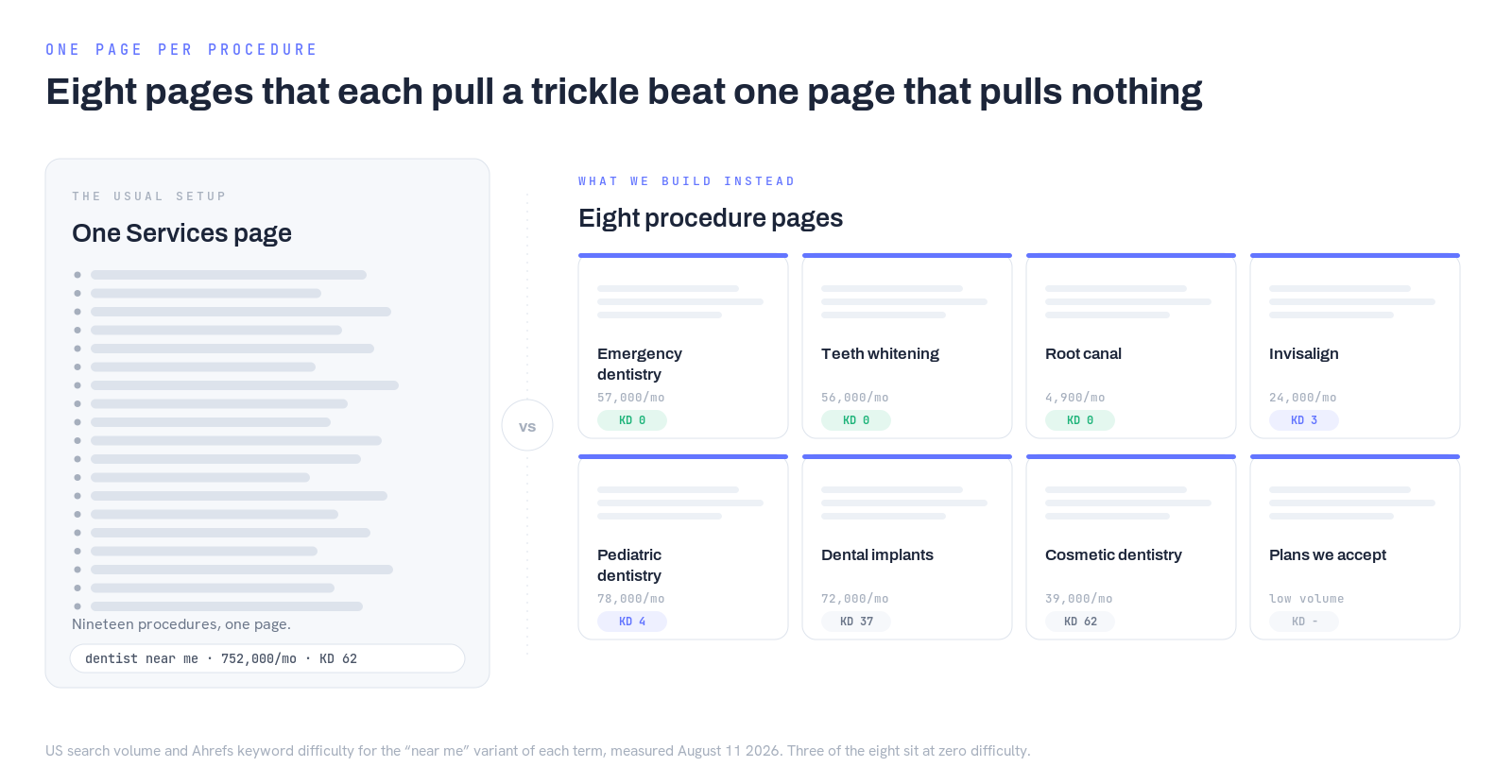
Eight pages that each pull a trickle beats one page that pulls nothing, and the trickle compounds because those pages also start ranking for the forty variations you never thought to target.
The searches nobody optimizes for
Insurance. “Dentist that takes Delta Dental” is a low-volume search with an enormous parent topic behind it, and the practices that publish a plain, current, honest page about which plans they accept and which they do not pick up patients who were going to call somebody else.

It is not glamorous work – it is a page that answers a question your front desk answers forty times a week, written down once, where a search engine can read it.
Local SEO for dentists and the map pack
The map pack is where a dental practice wins or loses, and it runs on a different set of rules than the blue links underneath it.
Three signals drive it: how complete and active your Google Business Profile is, how consistent your name, address, and phone number are across the rest of the internet, and how many recent reviews you have relative to the practices around you.
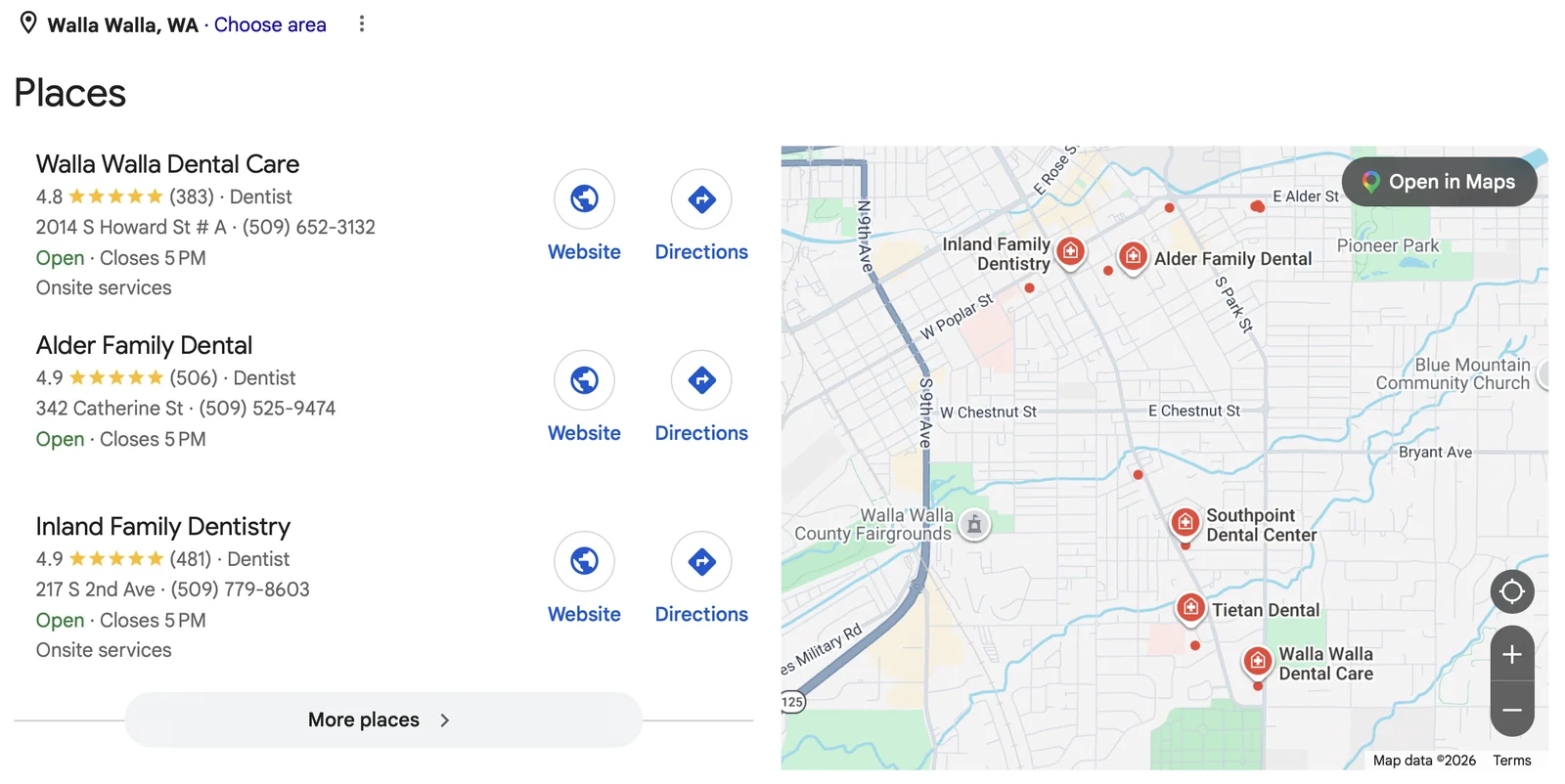
Proximity to the searcher is baked in and you cannot buy your way around it, which is why a practice can dominate its own zip code and be invisible six minutes down the road.
Google Business Profile is a living thing
The profile is not a form you fill out once. Practices that post to it, answer questions on it, keep hours accurate through holidays, and load real photographs of the actual office outrank practices that claimed the listing in 2019 and walked away.
Categories matter more than most people realize. A practice listed only as “Dentist” competes with everyone; a practice that also carries the right secondary categories for the procedures it actually performs shows up in searches its neighbors never see.
Reviews, and the part about velocity
Review count matters; review recency matters more.
A practice with 180 reviews where the last one landed fourteen months ago looks worse to Google than a practice with 60 reviews where three arrived last week. Steady beats impressive, which is inconvenient for anybody hoping to solve this in an afternoon.
Ask every satisfied patient, make it one tap, respond to all of them including the bad ones, and never buy them. Bought reviews get detected, and the recovery from a filtered profile costs more than the reviews ever bought you.
Citations and the boring hygiene work
Your practice information is sitting in a few hundred directories right now and some percentage of it is wrong.
Old suite number, disconnected fax line, the address from the office you left in 2017, a phone number with a tracking prefix somebody installed and forgot; every one of them is a small vote against you. The cleanup is genuinely tedious – which is exactly why it stays undone, and exactly why doing it works.
On-page SEO for a dental website
On-page is everything a search engine reads on the page itself, and for a dental practice it comes down to whether each page has one clear job.
One page, one procedure, one town, one question answered completely. A page trying to be about implants and veneers and sedation is a page that ranks for none of them.
Service pages that answer the whole question
Look at what a patient actually wants to know before they call about implants. What it costs, whether it hurts, how long the whole process takes, how many appointments, what the recovery is like, whether their insurance covers any of it, and what happens if they wait another year.
Answer all seven, in plain language, on the page; that is the entire content strategy, and it is harder than it sounds because it requires knowing your own numbers and being willing to publish them.
Content that is not a blog nobody reads
Most dental blogs are 400-word posts about the importance of flossing, published on a schedule, read by nobody, generated by a vendor who publishes the same post for eleven other practices.
The content that works is the content that answers a question your patients actually ask out loud. Why does my crown feel high.
Is a root canal or an extraction cheaper in the long run. What does an emergency visit cost if I do not have insurance.
Those get searched, and answering them well earns you the patient who was still deciding.
Schema, and the parts of it dentists should care about
Schema is structured markup that tells a search engine what things on your page are, rather than making it guess.
For a practice, the ones that earn their keep are the local business and dentist types, the FAQ markup on pages that answer questions, and review markup where it applies. It is quiet, invisible plumbing that helps AI systems and search engines read the page correctly, and it takes an afternoon once.
Technical SEO, speed, and the platform you are stuck on
A slow dental website loses patients before it loses rankings, and it loses both.
Somebody in pain on a phone on bad rural signal will not wait five seconds. Google measures that impatience directly and factors it in, so the performance problem and the ranking problem are the same problem wearing different hats.
Where the weight actually comes from
It is almost never the copy – it is a slider plugin loading three libraries, a hero video nobody watches, a chat widget that pulls in half a megabyte before the page paints, and eleven photographs uploaded straight off a phone at full resolution.
We build on WordPress with a hand-built block theme and no page builder, which sounds like a technical preference and is actually a speed decision. Page builders ship enormous amounts of code to handle every layout you might someday want, and you pay for all of it on every page load forever.
The vendor lock-in trap
A lot of dental websites live on proprietary platforms owned by dental marketing companies, and the site looks fine until the day you want to leave.
Ask the question before you sign anything. If we part ways, do I keep the website, the domain, the content, and the analytics history, and can I move all of it somewhere else.
A vendor who hesitates on that question has answered it.
Own your site. It is an asset on your balance sheet or it is a rental you are improving for somebody else.
What actually earns a dental practice links
Almost nothing does – and that is the good news.
Here is the finding that should change how you think about this whole category. I read the top ten results for “dental SEO” the morning I wrote this page, and the strongest page-level link profile in the entire top ten scored a 17 out of 100.
Everything below it scored 14 or lower. One of the pages sitting on page one has exactly two links pointing at it.
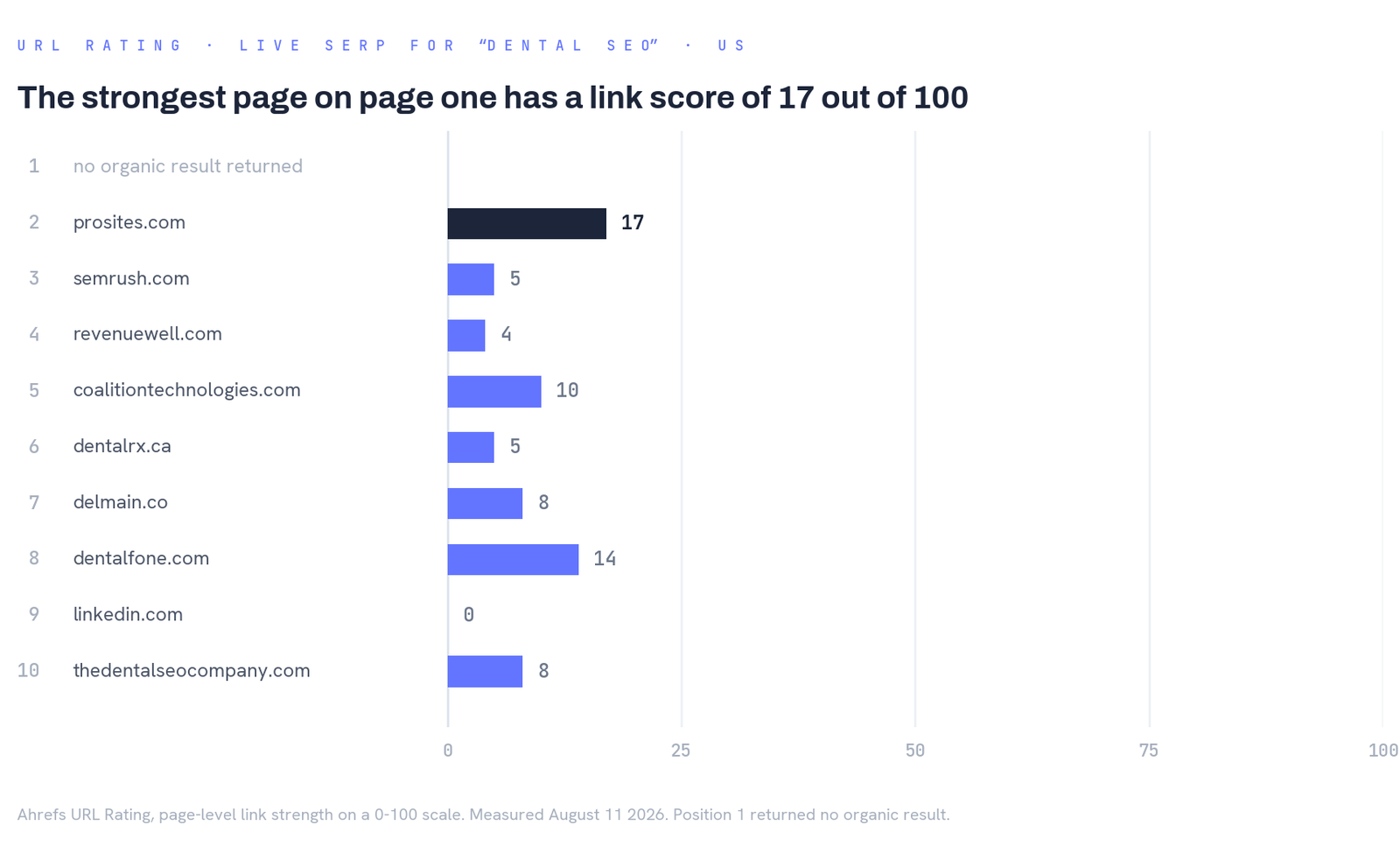
The pages winning this search are not winning on links.
They are winning on their domain’s history and on covering the topic, and for a local practice the equivalent is a real chamber of commerce listing, the school sports team you actually sponsor, the local news piece about the free clinic day you actually ran, and the dental school alumni page you actually belong to.
Six honest local links beat six hundred bought ones, and you probably already have four of them.
Dental SEO in the age of AI answers
Roughly a third of the search results a patient sees now are not links at all. They are answers, assembled by a language model, sitting above everything else.
The immediate instinct is panic, and the panic is mostly misplaced.
What changed
Fewer people click through on simple factual questions, because the answer is right there. “How long does a root canal take” is answered on the results page now and your blog post about it will get fewer visits than it did in 2023.
That is a real loss and it lands hardest on exactly the thin, generic, 400-word content that was never bringing in patients anyway.
What did not change
The systems generating those answers are reading the same web everyone else is, ranked roughly the same way, weighted toward the same signals. Google spent twenty years building a model of which pages are trustworthy and it did not throw that model out to build the new one.
A page that answers a question thoroughly, on a site that is fast and clean and locally credible, is the page that gets cited in the AI answer. The optimization did not change; the layer it feeds changed.
And when the question is “who should I see about this tooth,” nobody is satisfied by a paragraph. They want a name, a phone number, and a photograph of the building.
How we run dental SEO
Four phases, in this order, because doing them out of order is how practices spend eighteen months and get nothing.
Phase one – find the floor
We measure what you actually rank for today, what the practices around you rank for, which of their pages are pulling the traffic, and how deep the hole is. That measurement is the floor, and everything after this is raising it.
No work starts before this exists – a plan built without it is a guess with an invoice attached.
Phase two – fix the foundation
Site speed, mobile behavior, heading structure, internal linking, schema, and the technical debt that has accumulated since the site was built. This is unglamorous and it is the phase that makes every later phase work.
If the site is beyond repair we will tell you that, and we will also tell you when it is not, which is more often than most vendors admit.
Phase three – build the pages
One page per procedure, one page per location, written properly, published in priority order based on what the measurement said was winnable and valuable.
This is the phase that produces the results and it is the phase that takes real time, because these pages cannot be generated. A page that reads like it was generated performs like it was generated.
Phase four – feed it
Google Business Profile activity, review flow, new content against new questions, monthly measurement against the floor we set in phase one.
Think of a sourdough starter. It needs feeding on a schedule and it punishes neglect, but here is where the metaphor breaks in your favor: SEO gains do not die on the counter.
A page that reached the top three does not fall out of the index because you skipped a month. It stays, it keeps working, and the compounding continues whether or not you were paying attention that week.
What dental SEO costs
Cost is the most-asked and least-answered question in this entire category, and the reason is that a real number invites a real comparison.
We price by the work, on a monthly retainer that includes hosting and maintenance, and we will tell you before we start what the first ninety days looks like and what it should produce.
What the money is actually buying
In the first three months it is buying diagnosis and repair work you will not see on the front end of the site. That is the part that feels slow and it is the part everything else depends on.
From month four it is buying pages, one at a time, each targeting something the measurement said you can win. From month seven or so it is buying maintained position, new content against new questions, and the map pack work that never really finishes.
Contracts, and the question to ask
We do not do twelve-month lock-ins. If the work is good you will stay because leaving would be stupid, and if it is not good a contract is just a way to make you pay for a mistake on a schedule.
Ask any vendor two questions. What happens to my website if I cancel, and can I see the specific pages you built for a practice like mine.
Watch which one they answer faster.
How long dental SEO takes
Technical fixes show up in weeks. Map pack movement, if the profile work was genuinely undone, can move in thirty to sixty days and it is usually the first thing a practice notices.
New service pages take three to six months to settle into position, longer in a dense market, faster if the domain has some age on it and the page is genuinely better than what is there.
Meaningful traffic change is a six to twelve month conversation. Anyone promising page one in thirty days is describing either a search nobody performs or a lie, and the first one is worse because it looks like success.
How to choose a dental SEO company
You cannot evaluate the work directly, which is the entire problem, so evaluate the answers instead.
The five questions
Which specific searches will you target for my practice, and why those. A vendor without an answer has not looked, and looking is the job.
What did you find when you looked at my site. If they pitched before they audited, the pitch is a template – and you are on the list it went out to.
Do I own the website, the content, and the data. Covered above, and it is the one that catches the most vendors.
What happens in month one, month three, and month six – vague timelines mean vague plans.
Can I talk to a dental client you have had for more than two years. Anybody can show a first-year spike.
The tells
Guaranteed rankings – nobody controls the algorithm and anybody claiming to is either lying or targeting searches with no volume.
A price that is suspiciously round and suspiciously low – three-fifty a month, four-ninety-nine a month, same package for a solo practice in Walla Walla and a six-location group in Phoenix.
Reports full of impressions and no patients – impressions are the metric you show when the patients are not there.
See the work
These are real practices in real towns. Look at the work, look at where they show up now, and judge us the way Google would.
On whether it’s the genuine article.
Common questions
How long does dental SEO take to work?
Technical improvements register within weeks and map pack movement often appears in thirty to sixty days, but the change you actually care about – new patients arriving from search – is a six to twelve month timeline in most markets. Dense metropolitan markets take longer and a practice with an aged domain and a decent existing site moves faster.
Is SEO better than Google Ads for dentists?
They do different jobs and most practices should run both at different weights. Ads produce appointments this week and stop producing the day you stop paying; SEO takes months to build and then holds position through months of no spend.
A brand new practice leans on ads early and shifts weight to organic as it builds.
Do I need a new website for dental SEO to work?
Frequently no. Most existing sites can be repaired, sped up, restructured, and expanded without a rebuild, and we will tell you honestly which situation you are in.
The rebuild conversation is real when the site is on a proprietary platform you do not control or when it is slow in a way that cannot be fixed.
Can my office manager do our SEO?
Some of it, genuinely. Keeping the Google Business Profile active, collecting reviews, and answering questions on the listing are all things a motivated front desk can own and own well.
The technical work, the page architecture, and the content production are a different job requiring different tools, and the risk is not that it gets done badly but that it gets started and then abandoned in a busy month.
What is the difference between dental SEO and local SEO for dentists?
Dental SEO is the whole discipline including your service pages, technical health, and content. Local SEO is the subset aimed specifically at the map pack and geographic visibility.
Every practice needs both and local is usually where the fastest gains sit.
Does AI search mean SEO is dead for dental practices?
No, and the practices treating it that way are handing an advantage to the ones that are not. AI answers are assembled from the same ranked web, so the work that makes a page rank is the work that makes it get cited.
What did change is that thin generic content lost its remaining value, and for a practice that was never bringing in patients anyway.
There are people in your town searching for exactly what you do, right now, tonight, with a phone in their hand and a problem they want solved before morning. The only question on the table is whether they find you or the guy with the worse coffee.