




The arithmetic nobody puts on the slide
So the report says cost per click is down again, and the schedule looks exactly the way it did last quarter.
Cost per click is the number most of what gets sold as Google Ads for dentists is built on, because it is the one the platform hands you on the first screen of the report.
It is real, it is easy to move – and it tells you almost nothing about whether the campaign is working.
A practice can cut its cost per click in half by buying cheaper, vaguer traffic and end the quarter with fewer patients than it started with; the report will look like an improvement the whole way down. We have watched that happen to practices who thought they were winning.
The number that decides whether this is worth doing is cost per booked patient. Not per click.
Not per lead. Per patient who sat in the chair.
That number is harder to produce, because it requires the ad platform, the phone system and the front desk to agree with each other about what happened – which is exactly why almost nobody selling dental advertising builds their reporting around it. We build around it, and the rest of this page is mostly the consequences of that decision.
Work it forward and the whole thing stops being mysterious.
Clicks turn into calls at some rate. Calls turn into booked appointments at a worse one.
Booked appointments turn into patients only when people show up, and a patient turns into revenue only once you know whether they came for a cleaning or an implant.
Every one of those steps has a survival rate – and multiplying them together is the only honest way to know what a click is worth to your practice specifically.
The version below leaves the arithmetic visible so you can put your own numbers in. Say a hundred clicks arrive.
Some fraction of them call or fill in a form; some fraction of those calls get answered, which is the step that quietly ruins more dental campaigns than any targeting mistake; some fraction of the answered calls turn into an appointment on the schedule, and some fraction of those actually walk through the door.
If each stage holds up reasonably, a hundred clicks might produce a small handful of patients. If the phone goes to voicemail at lunch, it produces fewer – and no amount of bidding fixes it.
The phone is the leak.
That chain is why a practice with a five dollar cost per click can be doing better than a practice with a two dollar one; those two figures are made up to show the shape, and the shape is the point.
The cheaper clicks were people comparison-shopping a teeth whitening coupon, and the expensive ones were people typing emergency dentist near me at nine at night, and one of those is worth more than forty of the other. Intent is the whole product.
We ask for those conversion rates before we build anything. When a practice does not know them, finding out is the first month of work – and it is more valuable than any keyword we could add.
What a dental ads budget actually needs to be
Too small a budget does not produce a small result, it produces no result and no data.
This is the part that gets soft-pedalled in sales conversations, because saying it out loud costs the agency a deal.
Google Ads needs enough volume to learn – and a campaign spending a few hundred dollars a month in a competitive dental market will accumulate so few conversions that neither the algorithm nor you can tell signal from noise. You will have spent real money to acquire an opinion.
Not data. An opinion.
The budget question has a floor that is set by your market rather than by your comfort.
Dental search terms in a metro area cost multiples of what the same terms cost in a town of forty thousand – so a Walla Walla practice and a Seattle practice are not having the same conversation even though they are buying the same words.
The Tri-Cities sits in between, and it has been getting more expensive as the practices there get more sophisticated.
What we do instead of guessing is bound the problem from the other end. Decide what a new patient is genuinely worth to you over a couple of years; decide what fraction of that you are willing to pay to acquire one; multiply by how many patients a month you actually want.
That gives you a budget with a reason attached to it, and it is a much better answer than a number somebody picked because it sounded like a normal retainer.
If the arithmetic says you cannot afford enough volume to learn anything, ads are not your channel this quarter. That is a real finding and we say it out loud.
Dental PPC and the difference between a click and a chair
The gap between traffic and treatment is where practices lose the most money, and almost none of it is inside the ad account.
A booked chair requires five things to go right in a row. The ad has to be seen by somebody with an actual dental problem.
The click has to land on a page that answers the thing they searched for. The page has to make contact take one tap.
The phone has to be answered by a person. That person has to be able to book, on the spot, into the real schedule.
Break any one of those and the spend still happens, which is why we will not run ads for a practice that will not let us look at the phone side, because sending paid traffic into an unanswered phone is a way of paying Google to prove your front desk is busy.
The single highest-return change we have ever recommended on an ad account was not in the ad account. It was a receptionist.
The other half of the gap is patience with the wrong metric. Impressions and clicks move in days.
Booked patients move in weeks – and the practice owner watching the daily dashboard will feel a campaign is failing about ten days before it starts working.
Negative keywords, where most of the waste actually lives
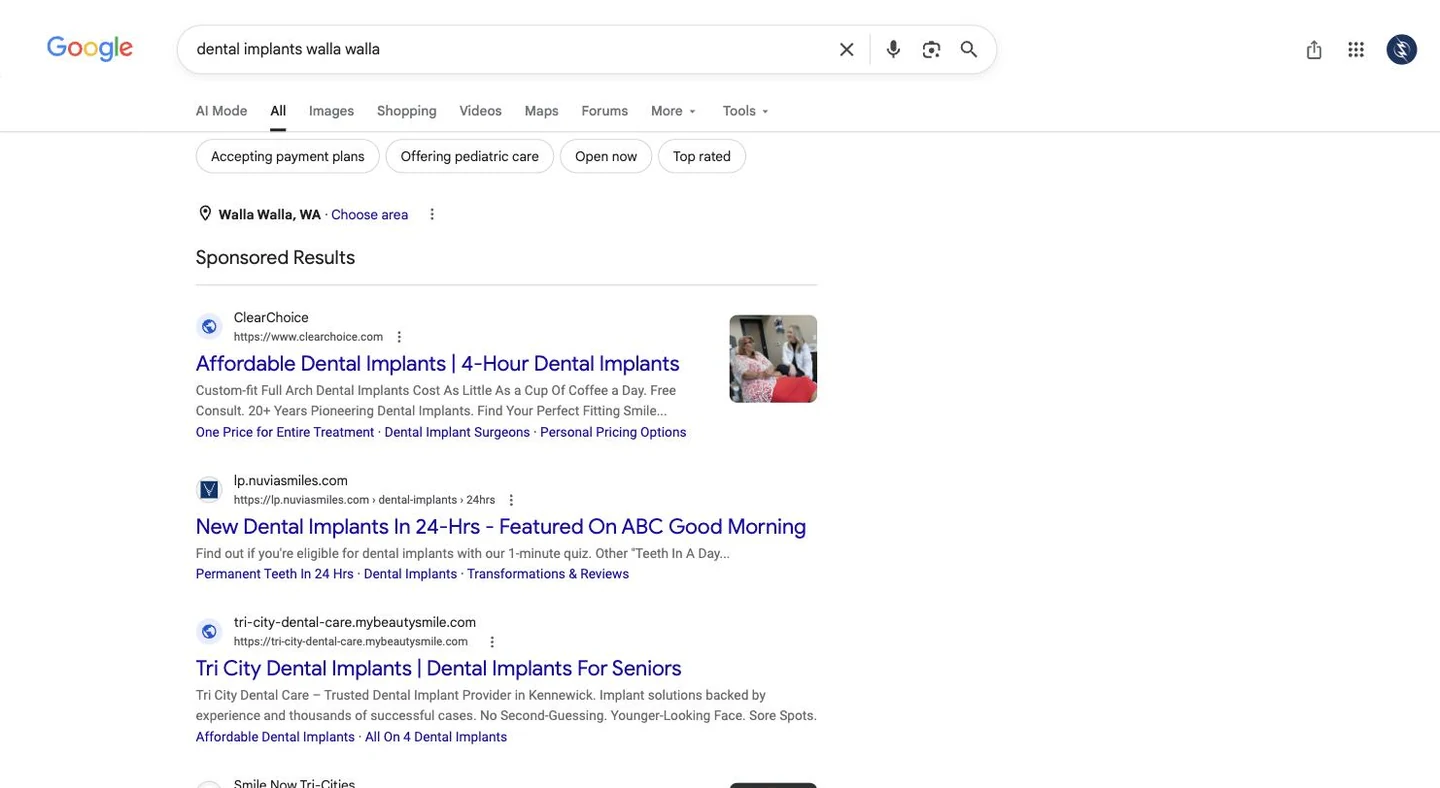
Google will spend your money on searches you would never have chosen, and it does not consider this a problem.
Broad match and the automated campaign types exist to find volume – and they are good at it.
What they are not good at is knowing that a dental practice does not want to pay for somebody searching dental assistant jobs, dental school requirements, free dental clinic, how to pull a tooth at home, or the name of a toothpaste.
Every one of those is a real query that has taken real money out of real dental accounts, and none of them was ever going to sit in a chair. Not one.
The work is a negative keyword list, built from your own search terms report rather than from a template – and revisited every week at the start. Job-seeker terms.
Do-it-yourself terms. Free and low-cost terms, unless you genuinely want that patient.
Competitor names, sometimes, depending on whether you want that fight. Insurance research terms that are asking a question rather than looking for a dentist.
Veterinary and pet dental terms, which show up more than you would believe.
There is a second kind of waste that negatives do not fix, and it hurts a multi-office practice worst of all: paying for clicks from outside your actual draw.
Somebody thirty miles away is unlikely to drive past four other practices to reach yours – and the radius that looks generous on a map is often just expensive. We tighten geography before we touch bids.
We do this work in public, meaning you see the search terms report and the list we built from it, and an agency that will not show you what your money bought is telling you something.
Match types, and the traffic you get when nobody is watching
The account settings that cost the most are the ones that were never deliberately chosen.
Broad match with automated bidding will find you volume and it will find it wherever it can.
Phrase and exact match give up reach for control, which in a dental account is usually the right trade, because there are only so many ways a person types root canal near me and most of the creative variations Google discovers are not people with root canals.
We generally start tight and open up deliberately, rather than starting broad and cutting for six months.
The same logic applies to the automated campaign types, and Performance Max will happily consume a dental budget across Search, Display, YouTube and Gmail, and the reporting will tell you far less about where it went than a standard search campaign would. There are practices where it earns its place.
A single-location general practice trying to fill next month’s hygiene schedule is usually not one of them.
Display network placement is the other setting worth checking on an inherited account. A dental ad appearing inside a mobile game is technically an impression and functionally a donation.
Landing pages that match the ad, because the alternative is paying twice
Sending paid traffic to your homepage is the mistake we find most often when we open a dental ad account, and it is usually the one costing the most.
The homepage is built to serve everybody: existing patients looking for the phone number, somebody checking the hours, a person deciding whether you take their insurance, and a new patient with a specific problem. It is a compromise by design.
Somebody who searched dental implants cost and landed on a homepage now has to find the implants information themselves, and a meaningful share of them will simply go back and click the next ad, which you also paid for. Twice, for the same person.
A landing page that matches the ad does four things. It repeats the language of the search back to the visitor, so they know they are in the right place within a second.
It answers the actual question, including the price question, because the practices that publish a range get called by better-qualified patients. It puts contact in reach without scrolling, on a phone, tap-to-call.
It removes everything that leads away from the decision, which usually means the full navigation goes.
Quality Score is the mechanical reason to do this as well as the human one – relevance between the keyword, the ad and the page affects what you pay per click and where you sit, so a matched page is cheaper than a mismatched one for the same position.
The build side of this sits on dental website design, and we build these pages on the practice’s own site rather than on a rented landing page platform, so the work is still there if the ads stop.
Call tracking, and how you learn which calls became patients
Without call tracking you are guessing, and the guess always flatters the channel that is easiest to see.
The mechanics are simple. A separate phone number is used in the ads, it forwards to the practice line, and every call is logged with the keyword and the search that produced it.
Dynamic number insertion does the same thing on the website, swapping the displayed number based on how the visitor arrived, so an organic visitor and a paid visitor are counted separately. Nothing about the patient experience changes; they dial a number and your front desk answers.
Call recording is where it gets genuinely useful and also where you should be careful. Washington is a two-party consent state, so recorded calls need an announcement, and a dental practice is handling health information on those calls, which puts a compliance question in front of you before a marketing one.
We set it up with that in mind and we tell practices to run it past whoever handles their compliance.
The part that no software can do is the last step, because somebody has to mark which calls became appointments, and which appointments showed up. It takes a receptionist about ten seconds per call and it is the difference between knowing your cost per booked patient and estimating it.
Ten seconds a call. Almost nobody does it.
Practices that do this get better advice from us, because we are finally looking at the same thing they care about.
PPC for dentists who also want to rank
Ads and search work are not competitors, and the case for running both is argued in full on dental SEO. We are not running it again here.
The short version is that they answer the same question on different clocks, and a practice that picks one on principle is usually picking with its cash flow rather than with its arithmetic.
The half of that which genuinely belongs on an ads page is a direction nobody expects. The ad account is the best keyword research tool a dental practice will ever own.
A search terms report is a list of what real people inside your actual radius typed into Google, with a conversion rate sitting next to every line, gathered in six weeks rather than estimated from a national tool that has never heard of Walla Walla.
When a term reliably books patients in the account, that is the next page we write on the site – and once the page ranks, the bid on that term can come down without the calls stopping.
That handoff runs one way, and it is worth being blunt about why. Ads tell you what to write.
Rankings do not tell you what to bid on, because the terms that rank easily and the terms that convert expensively are rarely the same list, and a practice that builds its ad account out of its best organic pages ends up paying for searches it was already winning for free.
We have talked practices out of exactly that.
The timing matters for the same reason.
Search work takes three to six months to become visible and six to twelve before new patients are arriving from it in numbers anybody at the front desk would notice, which is what decides whether ads are a bridge you are crossing or a line item you are keeping.
The broader menu of what a practice can do sits on dental practice marketing ideas, and the whole picture is on the marketing for dentists hub.
Campaign structure that survives contact with a real practice
Most inherited dental accounts have one campaign, one ad group and forty keywords in it – that structure cannot be managed, only endured.
The version that works splits by intent, because intent is what changes the value of a click. Emergency terms are their own campaign, they run at different hours, they use different copy, and they are worth a great deal more than anything else in the account.
High-value elective procedures like implants, Invisalign and veneers each get their own space, because the language, the page and the acceptable cost per patient are all different. General and new-patient terms make up the volume layer.
Brand terms, meaning people searching your practice by name, get separated so that they are not quietly inflating everybody else’s numbers.
That last one deserves a sentence of its own, because it is the way we most often see a dental ads report made to look good. Brand searches convert extremely well, they cost almost nothing, and folding them into the main campaign drags the average cost per conversion down to something impressive.
Those people were coming to you anyway. Reporting them as acquired patients is not exactly lying, but nobody does it by accident.
For a multi-location practice, campaigns split by office as well, with separate geography and separate tracking numbers. Otherwise you learn what the practice did and never what each office did.
When Google Ads for dentists is the wrong answer
Sometimes the honest recommendation is to spend the money on the website instead, and we would rather say it in the first conversation than in month five.
The clearest case is a slow site: paid traffic arriving on a page that takes eight seconds on a phone is money spent to watch people leave, and the fix usually costs less than a quarter of what the practice is spending on ads over the same stretch.
The second case is a practice with no capacity – if the schedule is already full for six weeks, ads will produce frustrated callers rather than patients, and the money should go into a hygienist or a chair before it goes into Google.
The third case is a phone nobody answers. We have said this twice on this page because it is the one we see most often and the most fixable.
The fourth is a practice whose real problem is retention, where existing patients are not coming back for their six month recall, because reactivating a patient you already have costs a fraction of what buying a new one costs and no ad account will ever tell you that. Ads will not surface it.
There is also the plain case of a small market with cheap organic opportunity. In a town where the map pack for your category is genuinely winnable, spending twelve months of ad budget on search work often produces a better second year.
We look at both before recommending either.
What Google Ads management costs
The range is set by account complexity rather than by budget size, and one location, one campaign structure, a straightforward general practice sits near the bottom. Multiple offices, separate campaigns per location, high-value elective procedures with their own landing pages and a call tracking setup that has to be reconciled with the schedule sits near the top.
We do not price management as a percentage of spend, and we think the practices doing it that way have an incentive problem baked into the contract.
An agency paid a percentage gets a raise every time it recommends spending more; nobody is immune to that, us included, which is why we removed it as a possibility rather than promising to be virtuous about it.
Ad spend is yours and goes on your own card in your own account, which you own outright. Landing pages are built on your site.
If you leave, you keep the account, the history, the pages and the data. We think that should be unremarkable, and in this industry it is not.
How long before the numbers mean anything
Four to six weeks before the data is usable, and the first two of those weeks will look bad.
That is how the system works. A new campaign starts by testing broadly, learning where the conversions come from, and getting expensive along the way.
The negative keyword list is thin because you have not seen the search terms yet, and bidding has no history to work with. Anybody showing you a triumphant week one is showing you noise.
Wait for week six.
By week six there is usually enough to make real decisions: which terms produce calls, which calls produce appointments, and where the money is going that should not be. That is the point at which the account starts getting cheaper per patient rather than just cheaper per click.
The honest longer view is that a dental ads account is never finished. Competitors change their bids, seasons move, a new practice opens on the same street – and an account left alone for six months quietly gets worse.
That is the actual argument for management, and it is a better one than any promise about optimization.
Common questions
How much should a dental practice spend on Google Ads?
Enough to gather usable data in your market, which is a different number in Walla Walla than it is in Seattle. Work backwards from what a new patient is worth to you and how many you want a month, rather than picking a round figure.
If that arithmetic does not clear the floor for your market, ads are the wrong channel this quarter.
How long until Google Ads brings in new patients?
Calls can start on day one. Usable data takes four to six weeks, and the first fortnight will look worse than the account eventually performs.
Judging a dental campaign inside three weeks is how good accounts get switched off.
Do Google Ads work for a brand new dental practice?
Better than almost anything else available in month one, because a new practice has no rankings, no reviews and no reason yet for Google to trust it, and the ad auction does not care about any of that.
The honest framing is that you are renting patients while the organic side matures underneath, and that is a six to twelve month wait before search is delivering new patients on its own. Budget for both from the start and expect the ads line to shrink rather than disappear.
Why am I paying for clicks that are not patients?
Almost always match types and a thin negative keyword list, which together let Google spend your budget on job seekers, students, price shoppers and people looking for a free clinic. A search terms report will show you exactly where it went, and it is usually an uncomfortable read.
Should ads go to my homepage?
No. A page matching the search converts better, costs less per click through Quality Score, and stops the visitor from having to hunt for what they came for.
Build it on your own site rather than a rented landing page platform.
Do I need call tracking?
If you want to know your cost per booked patient, yes, because otherwise the phone is a black box. It also needs somebody at the front desk marking which calls became appointments.
In Washington, recorded calls require an announcement and a health practice has compliance questions to answer first.
Can I run the ads myself?
You can, and some practices should, particularly a single location with a modest budget and an owner who enjoys this kind of thing. What usually goes wrong is not setup, it is the weekly maintenance: search terms, negatives, bids and the reconciliation with the schedule.
That is the part that decays quietly.