





What actually changes when you add a second office
Which of your two offices does Google show to somebody standing halfway between them?
The answer moves more of your month than anything on the website does, and it is the reason this page exists, because most of what gets written about SEO for dental offices quietly assumes one address, one phone number, one dentist and one map pack slot to win – and the moment you add a second location almost every piece of that advice starts working against you.
The pages compete with each other. The profiles blur into each other.
The reviews pile up on whichever office opened first, and the newer one looks like a startup by comparison, which it is not.
Meanwhile the searches themselves have split in a way nobody warned you about, because a person in Kennewick and a person in Richland are typing the same words and getting substantially different results.
The general case for search work in dentistry is covered on dental SEO, and we are not going to repeat it here. This page is about the harder version: several offices, several map pack entries to defend, and a market where the others have already hired somebody.
Everything downstream of geography changes, and nothing upstream of it does.
The upstream work is the same as it ever was. You still need a fast site, real procedure pages, correct schema and a steady arrival of reviews.
What changes is that every one of those things now has to be answered twice, and the two answers have to be different enough that Google can tell them apart while still being consistent enough that a patient recognizes the same practice.
That tension is the entire discipline of multi-location dental SEO, and most agencies resolve it by cloning – which is the wrong resolution.
There is also a quieter change that nobody mentions in the pitch. Your competitive set doubles.
A single office in Walla Walla competes with the general practices in Walla Walla; the day you open in College Place you inherit that town’s competitors too, and they have been building their profiles since before you signed the lease.
You are not the incumbent there and pretending otherwise in the content is a bad look that patients notice faster than algorithms do.
Proximity decides more than anyone selling you a ranking report wants to admit
Here is the uncomfortable arithmetic underneath every local dental search.
Proximity to the searcher is one of the heaviest ranking factors in the map pack, and it cannot be bought, written around or optimized away. A dental office on Main Street beats an identical office three miles out for a search made downtown, and loses the same search made from the other office’s neighborhood.
This is why a rank check performed on somebody’s laptop at your front desk is close to worthless, and why an agency that emails you a screenshot of a first-place ranking without saying where it was measured has told you nothing at all.
For a single-location practice this is merely annoying. For a practice with two or three offices it is the whole strategy, because your realistic goal was never to rank first across the county.
It is to own the grid around each chair, and then to fight for the overlap between them, which is where the two offices are quietly competing for the same person.
Tools like Local Falcon and BrightLocal measure this by running the same search from dozens of simulated points across a map and coloring in the results – and the picture that comes back is usually humbling and always more useful than a single number.
We measure before we quote, and we show the grid rather than describing it. A practice that has been paying for rank reports for two years is often looking at its real coverage for the first time.
The overlap zone, and which office is supposed to win it
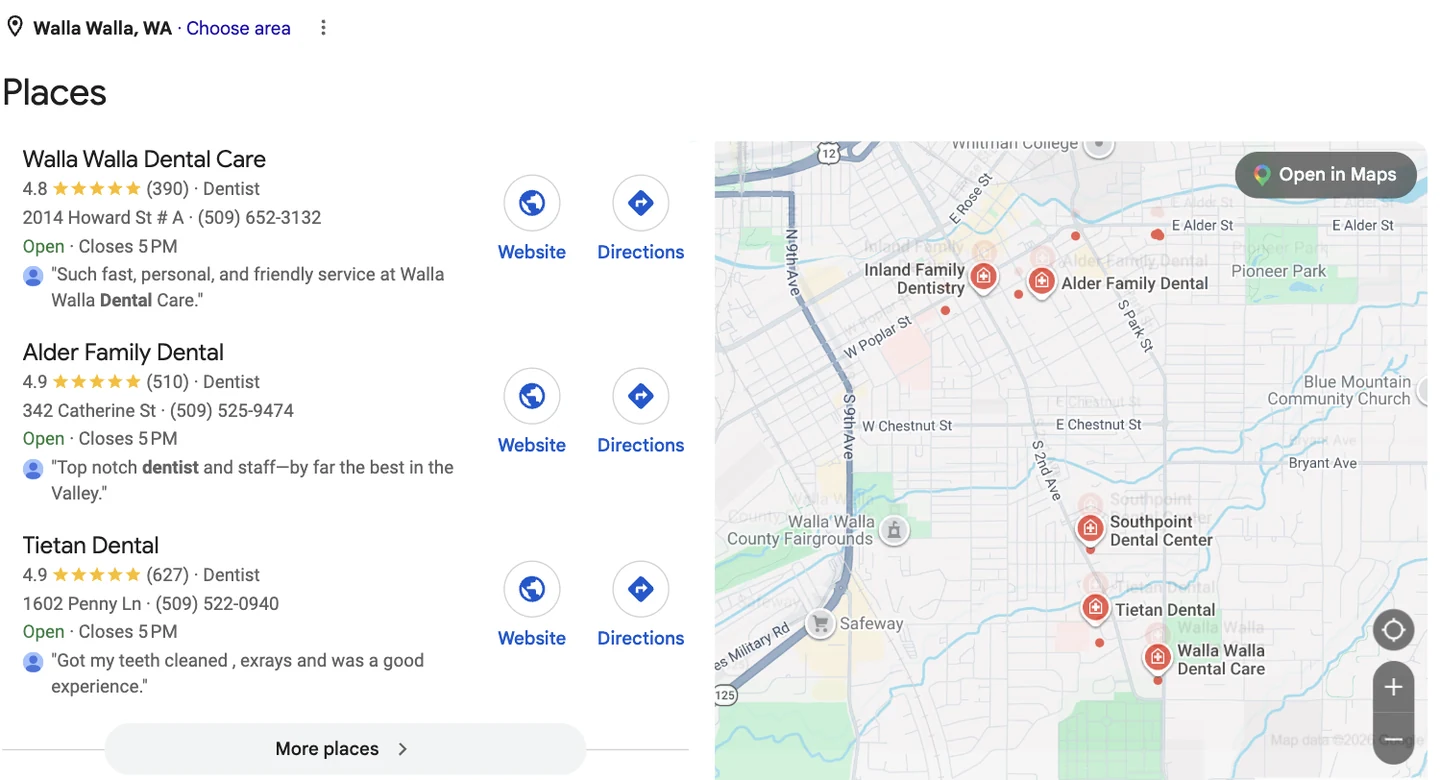
Two offices eleven miles apart have a middle, and somebody is going to rank in it.
The middle is the part nobody plans for. A practice opens a second office because the first one is full, picks a town far enough away that it feels like new territory, and then discovers that the neighborhoods in between search for a dentist too.
Both offices are plausible answers to that search. Google picks one of them, and it picks using proximity, review count and profile strength, not which office has the open chairs on Thursday afternoon.
It is not consulting you.
You can decide this instead of inheriting it, and deciding takes about an hour. Which office do you actually want that patient at, and why: the one with the surgical suite, the one with parking a nervous person can find, the one where the new associate needs volume.
Once that is settled the work is specific and slightly ruthless. The location page for the office you picked names the towns, the school district and the highway exit in the overlap, and the other location page does not mention them at all.
The internal links from the implants page point at the office that places implants. The review push runs harder at the chosen office for a quarter, because velocity is the lever that moves fastest in a tie.
The service list on the other profile stops advertising the thing you would rather send across town.
What most practices do instead is write both location pages as though the entire county belongs to them, and then wonder why neither office holds a position in the middle. Splitting your own signals is the only kind of competition where both sides lose.
We map the overlap before either page gets written. It takes an afternoon with a grid scan and one honest conversation about which chairs need filling.
The cannibalization problem, which is where multi-location practices lose
Two location pages that say the same thing do not double your chances. They halve them.
The mechanism is simple enough once somebody explains it. When two pages on the same domain target the same intent, Google has to pick one, and it is not obliged to pick the one you would have chosen.
Sometimes it picks the weaker page because an old internal link points there. Sometimes it alternates between them week to week – and your ranking looks unstable for reasons that have nothing to do with your competitors.
Sometimes it just downgrades both, because neither page looks like the definitive answer and one of your rivals has a page that does.
Dental practices walk into this constantly, and almost always in the same two ways. The first is location pages generated from a template with the city name swapped, which is the technique we see abused most in local SEO and the one Google spent a decade learning to ignore.
The second is subtler and more damaging: a procedure page for implants at the main office, and a second procedure page for implants at the other office, both written by the same person from the same outline in the same week.
The fix is structural rather than clever. One canonical page per procedure for the practice, written to be the best page on the internet about that procedure, and one genuinely distinct page per location that is about that place rather than about that service.
The procedure page links down to both locations. The location pages link across to the procedures actually offered there, which are often not the same list.
Nobody duplicates anybody.
How a location page earns its place on the site
A location page that could describe any office in America will rank for nothing, and it deserves to.
The test we use is blunt. Cover the address and phone number, hand the page to somebody from the other office, and ask whether they can tell which location it is.
If they cannot, the page is filler and Google is treating it as filler. If they can, you have written something that is worth indexing.
What makes it pass that test is specifics, and dental practices have more of them available than they realize. Which doctors actually work at that office and on which days.
Which procedures are performed there rather than referred out – because the second office often does not have the cone beam scanner and pretending otherwise wastes a patient’s afternoon. Parking – which sounds trivial and is the thing anxious patients actually worry about.
The insurance plans taken at that office if they differ. The hours, including the Friday nobody is open.
Real photos of that building, not the other one.
Then there is the geography itself, and this is where most practices get shy.
Naming the neighborhoods, the schools, the highway exit and the landmark across the street is not keyword stuffing when it is true, and it is how you signal to both a search engine and a nervous human that this office is genuinely in their part of town.
A page for a Kennewick office should read like it was written by someone who has driven to it.
Dental practice SEO in a market where everybody already hired somebody
There is a version of this work for a town where nobody has done it, and a different version for a town where everybody has.
In the first case the wins are almost embarrassing.
A correct primary category, a profile that gets touched more than once a year, and eight real procedure pages will move a practice into the top three in a small market inside a few months – and the practice will assume we are geniuses when really we were the only ones who showed up.
Walla Walla has categories that still look like this. Not many, and fewer every year, but they exist.
In a competitive market none of that is a differentiator, because your three closest rivals have already done it.
What separates practices then is depth and patience: more pages, better pages, pages that answer the question after the question, a review pipeline that produces something every week rather than something every quarter, and links that a real human decided to give you.
It is slower and costs more – and the honest framing is that you are buying a position you have to keep paying to hold.
The Tri-Cities is meaningfully harder than Walla Walla for exactly this reason – and a practice moving between the two markets should expect a different timeline and a different bill. We will tell you which one you are in before you sign anything, because getting that wrong sets an expectation that the work cannot meet.
One Google Business Profile per office, and the parts that must differ
Each office gets its own profile, its own verification, its own phone number and its own hours. That part is not optional and Google is explicit about it.
How to keep any one profile healthy – the posting, the hours, the photographs, the questions people leave on it – is covered on dental SEO and we are not writing it again. The multi-location question is a different one.
It is only about which fields have to match across your profiles and which have to differ. The business name matches everywhere, punctuation included, because a system deciding whether three listings belong to one practice reads the name first, and inconsistency there is the mistake we clean up most often on a multi-office account.
The primary category usually matches too, unless the offices genuinely do different work – which happens more than people expect when one location is the surgical site.
The parts that should differ are the parts a human would notice. Separate tracking numbers so you know which office the call came from, forwarding to the right front desk.
Photos of that building and that team. Service lists reflecting what actually happens there.
Q and A answered per location, because the questions differ. Posts that mention the actual neighborhood.
The failure we see most often is a second office verified once, in a rush, by whoever was available, and then never touched again while the original office gets all the attention. Six months later the newer office is invisible and everybody blames the market.
It was not the market.
Reviews when you have more than one office
Reviews do not pool. A patient who leaves a glowing review on the main office profile does exactly nothing for the second location, which surprises practice owners most.
Why reviews matter, and why recency matters more than the total, is argued on dental SEO.
The part that page cannot tell you is that every mechanism it describes has to be built and run once per office, in the office, by the people who saw the patient – and that a practice reading its review numbers at the practice level will not notice for a year that one location has stopped growing.
So the system is per office by construction. The text goes out an hour after the appointment, sent from the location that treated the patient, with a link that lands on that location’s form in two taps.
The front desk that saw the patient is the desk that asks. A single practice-wide request list defeats the whole exercise, because a review describing an extraction done in Kennewick, sitting on a Richland listing, is worth less to you than no review at all.
That construction is also the good news for a newer second office, and it is the thing owners find hardest to believe. The new office does not have to catch the older one’s total, which it never will, and it does not need to.
It needs to look alive. A location open eight months can look alive faster than an established office three towns over that stopped asking in 2023, and looking alive is most of what a person choosing between two map pack results is actually reading.
One thing to avoid entirely: routing every patient to whichever profile needs reviews most this month. It is transparent, it puts reviews for work done at one office on the profile of another, and it is exactly the kind of thing that gets a listing suspended.
The practice you bought, and the domain that came with it
An acquisition arrives with a website, a Google Business Profile, a pile of reviews and somebody else’s name on all three.
That inheritance is the most valuable thing in multi-location dentistry and it is thrown away constantly.
The practice you bought has been on that street for twenty years; its domain has links from the chamber of commerce, the school district newsletter and the local paper, and its profile carries four hundred reviews that took two decades to accumulate.
The new owner’s first instinct is almost always to switch the old site off and point the domain at the new one, which discards the twenty years and keeps the URL. Keep the twenty years.
The version that works is slower and it is not complicated. Keep the acquired domain alive and redirect each old page to the page on your site that answers the same question, rather than sending every address to your homepage, which tells a search engine that none of those pages had a successor.
Keep the redirects in place permanently, because a redirect you remove after a year is a link you handed back.
On the profile side you do not create a new listing, you edit the existing one, since a new listing starts at zero reviews and the old one does not – and the reviews stay attached to the location where the work was actually done, which is where they belong and where a patient expects to find them.
The part that takes judgment is the name. A practice with real equity in its old name is sometimes worth keeping as a name, and folding it into your brand in the first month costs you the recognition you just paid for.
We have seen owners rebrand a forty-year-old practice in week two and then spend a year explaining to the town that they are still open. Staged is better.
Both names for a while, then one.
Relocations follow the same rules with one addition.
The profile is moved rather than replaced, the old address disappears from every place on the site including the footer and the schema, and you should expect the grid around the new address to take a couple of months to look anything like the grid around the old one.
Proximity does not care that it is the same practice.
Procedure pages, location pages, and how not to end up with forty of them
The multiplication is the trap. Eight procedures times three locations is twenty-four pages nobody will ever write well – and a practice that tries produces twenty-four pages nobody reads.
The architecture that holds up is a grid you deliberately refuse to fill. One page per procedure for the whole practice, written once and written properly – what belongs on it is covered on dental SEO, and the answer does not change because you have three offices instead of one.
One page per location, written to the test in the section above. Then, and only then, a small number of combination pages where the search volume genuinely exists and the content would genuinely differ.
That last category is smaller than any agency selling page count will admit. In a market the size of the Tri-Cities there may be two or three procedure-plus-city searches with enough volume to justify a dedicated page – and implants is usually one of them.
Everywhere else the location page and the procedure page together do the job, and the internal links between them do the rest.
Keyword research decides which pages exist, and it should be done per market rather than once for the practice. The searches in Walla Walla and the searches in Pasco are not the same list – and the volumes are small enough that a difference of thirty searches a month changes what is worth building.
Where the site and the profiles contradict each other
None of the above survives contact with a slow site, and the technical floor is the same floor for a practice with four offices as it is for a practice with one chair. Speed, heading order, URL structure and schema are covered on dental SEO.
We build to that floor as a matter of course and there is no multi-location version of it.
What is specific to several offices is that the site now has several chances to disagree with itself, and it takes them. A footer listing the suite number from before the move.
An appointment form that routes to one front desk no matter which location page it was sitting on. A phone number baked into an image on the second office’s page, which is of course the number that changed in April.
A location page describing hours that moved in the spring while the profile for the same office says something else entirely. Each of those is small.
A system whose whole job is deciding whether three listings are really one practice is reading every one of them.
The pattern underneath is nearly always the same, and once you have seen it you cannot stop seeing it: a site that was built for one office and had the others bolted on afterward. It shows in the navigation, where the second location lives somewhere under About.
It shows in the schema, where one set of address and hours details is doing duty for a practice that has three addresses. It shows in a contact page that is singular in a business that is not, and in an about page written when there was one doctor.
None of that is cosmetic, and none of it gets fixed by adding another page.
We build sites this way from the beginning, which is most of the reason our search clients need less remedial work than they budgeted for. The build side of that argument sits on dental website design.
Dental office SEO measurement that survives a hard question
If your reporting cannot answer “how many new patients did this produce”, it is not reporting, it is decoration.
The measurements that mean something are short and specific. Grid coverage per office, run monthly from the same points, so improvement is visible as area rather than as a single flattering rank.
Calls per office, tracked with a number that is unique to the source, because a practice with two locations and one phone number cannot tell where anything came from. Booked appointments from those calls, which requires the front desk to write down two things and is the step almost every practice skips.
Search Console impressions and clicks by page, which tells you which pages are actually working rather than which ones you liked writing.
What we do not report is rankings measured from our office, traffic without context, or a keyword count that went up because we added keywords nobody searches. A report that only ever contains good news is a report somebody is curating.
The honest part is that attribution in dentistry is imperfect and always will be. Somebody sees the map pack on Tuesday, asks a neighbor on Thursday, and calls on Monday after typing your name directly into Google – and the last click gets the credit while the map pack did the work.
We will show you the whole shape rather than the one number that flatters us.
Which office gets the budget first
A practice with three offices and one budget is running three campaigns whether it decided to or not.
Spreading the work evenly across the offices feels fair and it is usually the wrong call, because the offices are not in the same market, are not at the same stage, and do not have the same amount of empty chair time.
An office already booked six weeks out does not need more visibility this quarter; it needs a hygienist. An office that opened in March in a town with four established competitors needs a year of work rather than a third of one, and giving it a third of one produces nothing anybody can point at.
Nothing worth reporting.
So the question we ask first is which office has the most unfilled capacity sitting in the least contested market, because that is where the same money produces patients soonest and the wins there pay for the harder fight somewhere else.
It is rarely the newest office, and it is rarely the flagship, which gets the attention by default because it is where the owner sits and where the owner reads the report.
There is a second reason to sequence rather than spread, and it decides the year. Content, reviews and links all compound, and they compound per office rather than per practice – so half an effort in three towns produces three practices that are almost visible, which is a position with no revenue attached to it.
Finishing one office and moving to the next produces one office that ranks and two that are waiting. That is a better place to be standing in month nine, and it is a much harder thing to explain to the partner who owns the office that is waiting.
We put the order in writing before the first month, with the reasoning next to it, because that argument is far easier to have in advance than in month four.
When SEO is the wrong place for the money
Sometimes the answer is that you should not buy this yet, and it costs us work to say so.
A practice with a site that takes nine seconds to load on a phone should fix the site first, because search work aimed at a broken site is an expensive way of proving the site is broken. A practice with one services page listing nine procedures needs content before it needs a retainer.
A practice that cannot answer the phone at lunch has a front desk problem wearing an SEO costume, and no amount of ranking fixes it. A new second office in a competitive market may be better served by paid search for the first few months while the organic work matures.
We would rather tell you that in the first conversation than discover it together in month five. It happens often enough that we built the habit of looking before quoting.
What SEO for dental offices costs
For each office that means the profile rebuilt from the categories up, the directory records corrected wherever they disagree, a review routine the front desk at that office can actually run, schema that describes that address, and whatever pages already exist repaired instead of thrown away.
It is a real piece of work with an end – and we price it that way rather than folding it into a retainer that never finishes.
Dentistry sits above general small business search work for reasons that are not us being clever about pricing: the searches are worth more per patient, the practices around you have already hired somebody, and the writing is about clinical procedures rather than about a service anybody could describe in an afternoon.
Where you land inside that range is mostly offices and mostly pages. One office in a small market, foundation already done, a page or two a month, sits near the bottom of it.
Two or three offices – each needing its own location page, its own review pipeline, its own grid scan and its own share of the procedure content – sits in the upper half because there is simply more of everything to do.
A contested market where the position has to be taken off a practice that already holds it sits at the top, and that is a different job from claiming an empty one. We will tell you which of the two you are in before you commit, because the difference is diagnosable in an afternoon.
What we will not do is quote you a smaller number by quietly doing less. The work that moves a multi-office practice is content and reviews, both of which somebody has to actually produce every month, and a retainer priced below the work buys you a report about the work.
Website work is priced separately and so is anything paid. The full picture across services sits on marketing for dentists.
How long it takes, per office
The profile side of a neglected second office is the one place where a change lands in weeks rather than quarters. A wrong primary category corrected there is the fastest win available anywhere in this discipline, and it is also the least representative one, so we mention it and then tell you not to expect it.
The foundation itself takes three to four weeks per office, and offices can run in parallel. The review pipeline and the citation corrections begin registering inside the first quarter.
That is encouraging. It is not a result.
A new procedure page needs three to six months before it holds a position worth having, and the thing you are actually buying, which is patients arriving from search, is a six to twelve month window whether you run one office or four.
The shape of a first year is consistent enough that we describe it in advance. Something moves in month one.
The graph looks flat and disappointing somewhere around month four, which is when most practices quit and the reason so many of them believe SEO does not work. Month nine is usually when the phone starts ringing differently.
The middle is real, it is survivable, and knowing it is coming is most of what gets a practice through it.
There is no version of this that runs faster, and a practice with three offices is three times as exposed to a vendor who sells speed, because the cleanup afterwards happens three times over too.
Common questions
How is SEO for a dental office different from regular local SEO?
The mechanics are the same and the stakes are not. Dental searches are high-intent and high-value, the map pack takes most of the clicks, and a single new implant patient can pay for a quarter of search work, which changes what is worth spending.
Multiple locations add a cannibalization problem that most local businesses never face.
Can two of my offices both rank in the same map pack?
Rarely, and you should not plan on it. Google usually filters multiple listings from the same business out of a single result set, so two offices in the same town mostly compete rather than stack.
The realistic goal is each office owning the grid around itself.
Should each office have its own website?
Almost never. Separate sites split your authority, duplicate your content and triple the maintenance; they are usually recommended by somebody who bills per site.
One domain with a strong location page per office is the better structure in nearly every case we have seen.
How many location pages do I need?
One per office you actually operate, and none for places you merely serve. Pages for towns where you have no address rarely rank and often dilute the pages that could.
If you genuinely draw patients from a nearby town, that belongs inside the nearest office’s page rather than on a page of its own.
Why did my rankings drop when we launched the second location?
Usually cannibalization. Two pages targeting the same intent make Google choose, and it sometimes chooses badly or alternates.
It is fixable with structure, canonical choices and internal linking; it is the reason we find most often when a practice’s traffic falls right after an expansion.
What happens to our rankings when an office moves to a new address?
You move the profile rather than replacing it, and you strip the old address out of the site everywhere it appears, including the footer and the schema. Then you wait, because the grid around a new address takes a couple of months to look anything like the grid around the old one.
Proximity does not care that it is the same practice with the same reviews.
Do you work with practices outside Walla Walla?
Yes. We are in Walla Walla, we work across the valley and the Tri-Cities in Kennewick, Richland and Pasco, and the method does not change with the map.
What changes is how hard the market is, and we will say which one you are in.
Should each of our offices have its own phone number?
Yes, and a tracked one. A practice with three locations and a single number cannot tell you which office a call came from, or which office a month of work actually filled.
Each profile carries the number for that front desk, forwarding wherever you like behind the scenes. The rule that matters is consistency: whatever number sits on the profile also sits on that location page and in that location’s schema, never the head office number.