






What an AI SEO agency actually does for you
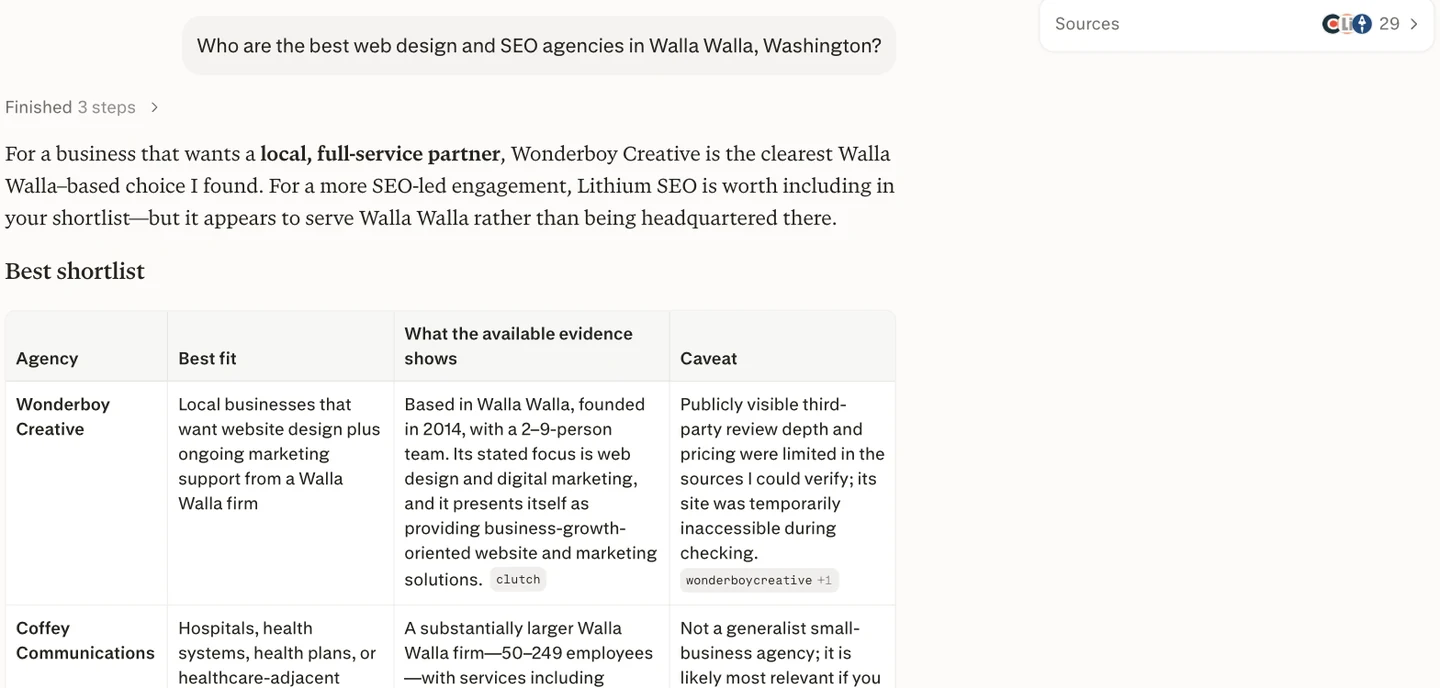
Ask an assistant who the good dentists in Walla Walla are and it will name three or four, in a paragraph, in about four seconds.
Sit next to an owner while that happens and you can watch the moment land. She reads the names. Two are competitors she knows by their first names, one is forty minutes up the highway in Kennewick, and the fourth is a practice she has never heard of. Then she scrolls, which is the reflex, and there is nothing under the paragraph to scroll to.
Most of what an AI SEO agency sells is work that already had a name before any of this: clean markup, a website that states plainly what a business is and where it operates, listings that agree with each other, and enough coverage elsewhere on the internet that a stranger could check the claim without taking your word for it. We sell it too, so read that as a confession rather than a cheap shot. The work did not change much. What changed is which machine reads it – how few sources that machine names when it answers a question, and what it costs you to be left off that very short list.
The genuinely new part is real, and it is a smaller share of the job than the pitch suggests. It is still worth doing, because a business that gets named in an AI answer tends to get named again, and a business the model has never resolved into a real thing does not get named at all. Three names, four on a good day, and then the answer stops.
The rest of this page is the commercial half of the subject. What we actually do, what lands in your hands, what it costs, and how to tell somebody doing the work from somebody who retitled a slide deck last spring.
Strip the language off and there are four jobs, and every honest shop in this category is doing some mix of them.
The first is making your business legible: one name, one address, one phone number, one description of what you do, repeated consistently everywhere a machine might look. The second is making your pages quotable, which mostly means answering the question in the first two sentences instead of the eighth paragraph. The third is getting your business referenced somewhere that is not your own website, because a model treats a claim you make about yourself differently from a claim somebody else makes about you. The fourth is measurement, which is the weakest part of this whole field and the part where the most nonsense gets sold.
That is the service. It is not glamorous and it does not require a proprietary platform – and any agency telling you otherwise is charging you for a dashboard.
We do this alongside regular search work rather than instead of it, because the same fixes move both. A page that a model can quote cleanly is also a page that earns a featured snippet, and a business with consistent listings ranks better in the map pack as a side effect. You are rarely choosing between the two.
What moves the scope
Three things move you inside that range and all three are countable. The number of listings that turn out to exist, whether the site has usable markup already or three plugins arguing, and how many pages carry your money terms. A single-location shop with a tidy profile and five service pages sits at the bottom. A practice with two locations, a rebrand in its history and forty pages sits at the top, and we will tell you which one you are before you pay anything, because it is visible from outside.
What the work is does not depend on a call to find out. Describing it plainly costs us a few conversations with people who were never going to buy, and it saves everybody the discovery call theater. Everything below this is what those two numbers buy, row by row, so you can check the price against the work instead of the other way around.
Most AI SEO services are technical SEO wearing a new label
Sit through five pitches for AI SEO services and you will hear the same five deliverables described in four different vocabularies.
Schema markup. Internal linking. Content restructured into question-and-answer shapes. Digital PR. A crawl audit. Every one of those items was on an SEO scope of work years ago, and every one of them still belongs there. Relabeling them is not fraud; it is marketing – and it works because business owners are being told daily that something enormous has changed and they should be worried.
The reason this bothers me is not the label. It is the pricing that rides along with it. The same audit that was two thousand dollars in 2022 is now six thousand dollars because the word AI is in the file name, and the deliverable is a spreadsheet with the same forty rows.
If you already have an SEO provider doing genuinely good technical work, you are further along on AI visibility than you think, and the honest advice is often to add a narrow piece rather than start a new engagement. We have told people that and lost the sale. It is a bad business habit and I have not managed to break it.
The part that is genuinely new, and it is smaller than the pitch
Three things here had no clean equivalent in old-school SEO, and it is worth naming them precisely so you can see what the premium is meant to be buying.
The answer surface names a handful of sources instead of ten, which means fourth place is worth something in search and worth nothing in an answer. Models work from a compressed, secondhand impression of your business rather than from your website directly, so what other sites say about you carries more weight than it used to. And there is no rank tracker, no position and nothing resembling Search Console coming out of the assistants, which means we are asking you for patience with less evidence than usual.
That is the whole of the new part, in three sentences. The mechanism behind each of them is worked through properly on LLM SEO rather than repeated here, because this page is about the invoice.
Everything else on the scope of work is old work done more carefully. That is not a complaint about the category; it is the reason the price should not have doubled.
Answer engine optimization, generative engine optimization, and what changes on the invoice
You will be quoted for this work under at least four different names, and the proposals will look like four different products.
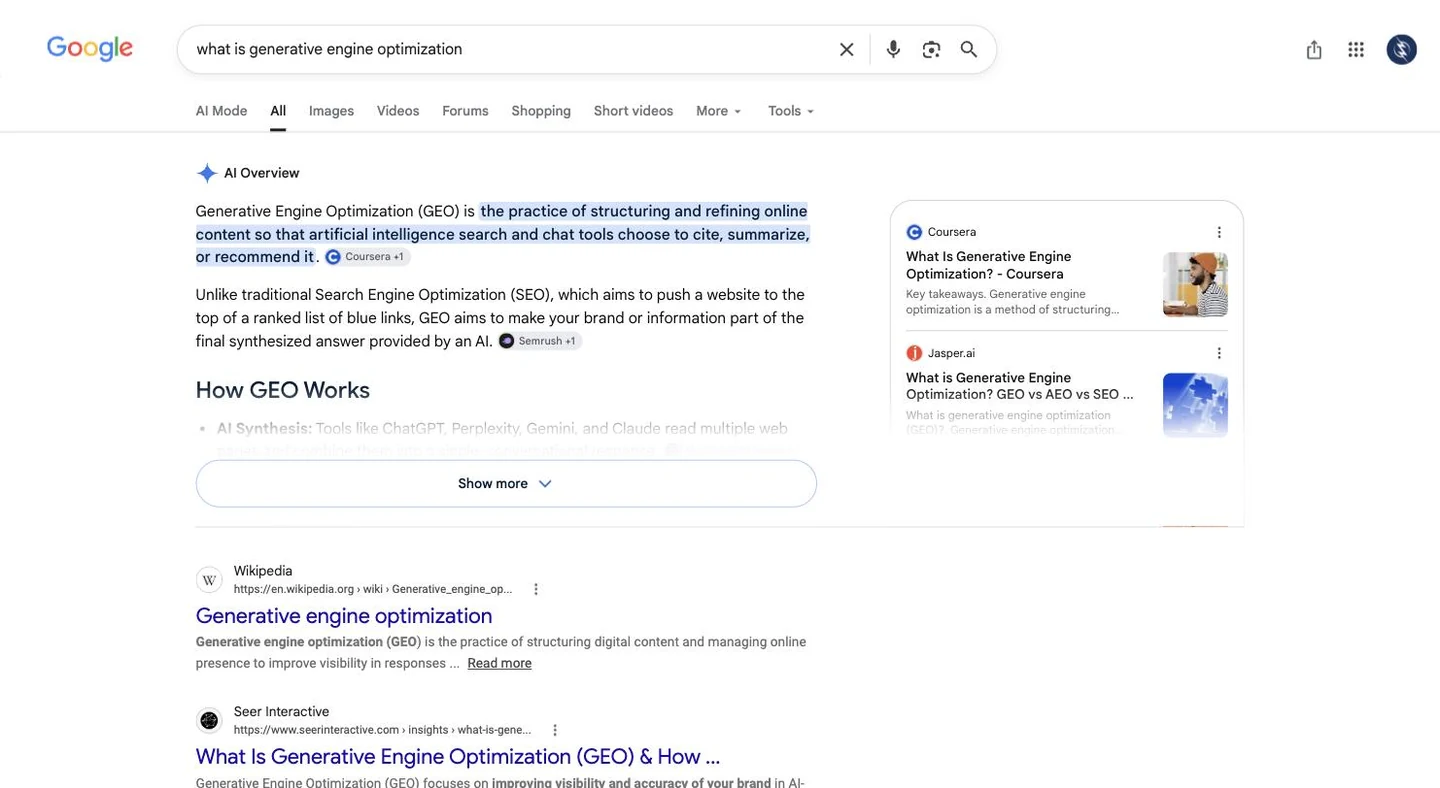
Answer engine optimization is the one most agencies lead with. Generative engine optimization tends to show up on the more expensive deck. Nothing underneath either of them differs enough to change what gets done, and we use whichever name the client walked in using. The reason to care is procurement rather than theory. If two proposals are sitting on your desk in two different vocabularies, the only way to compare them is to ignore the headings entirely and read the deliverable rows, because the vocabulary is doing no work at all. Ask each shop to describe the difference in what they will actually change on your site. There usually is not one.
Where those names do map onto genuinely different surfaces, and where the emphasis shifts between them, is explained on LLM SEO. For the purposes of buying something, treat all four as one line item and price it as one.
One tell worth keeping in your pocket. A shop that has invented a fifth name of its own, capitalized it, and put a trademark symbol after it is charging you for the trademark.
The audit we start with
Every engagement opens the same way, and the first pass is deliberately unromantic.
We ask the assistants the questions your customers would actually ask. Not your brand name, because your brand name is the easy case and it flatters everybody. The real questions are the category ones: best dentist in Walla Walla, who does wine club websites, plumber near Kennewick who works weekends. We record what comes back, which businesses get named, and which sources the answer leans on when it shows them.
Then we check whether your business resolves as a coherent thing at all. That means looking at your listings, your profile, your site’s markup, the directories in your category, and whether the description of your business is the same in all of them or four different descriptions written by four different people over nine years.
Then the ordinary technical pass, because a site the crawlers struggle with is not going to be quoted by anything. The output is a document that says what is wrong, in what order it should be fixed, and what we think it is worth. Some of those rows are things you can do yourself in an afternoon, and they are marked that way.
The entity clean-up, and what lands in your hands
An entity is the machine’s one confident idea of your business, and if the internet describes you four ways there is no such idea available to have. Why that costs you an answer is LLM SEO material. What we do about it is a fixed job with an end, and this is the shape of it.
We start by finding every place your business is currently described. The Google profile, the Apple and Bing listings, the industry directories in your category, the chamber, supplier and partner pages, the old review-site entry nobody has logged into since 2019. Each one becomes a row carrying the name, address, phone, category and description exactly as they read today. That sheet is the deliverable owners underestimate, because it is usually the first time anybody has seen every version of the business in one column.
Then we reconcile it. One spelling of the name, including whether it takes an ampersand or the word and. One address, down to the suite number. One primary category, chosen for what you want to be known for rather than for whatever the person filling out the form clicked first. One description, in recognizably the same sentence everywhere. Where a listing cannot be edited without ownership, we tell you which login we need or which claim process you have to run yourself, and that is a short specific list rather than a vague ask.
What you get back is the before-and-after sheet, the logins you did not know you had, and a note on every row we could not move and why. It is priced as a one-time engagement rather than a subscription because it genuinely finishes, and it stays finished until you move, rebrand or open a second location. Any of those is an hour of work later, not a new project.
The thing we will not do here is manufacture listings on directories nobody reads so the row count looks impressive. Sixty citations is padding with a number on it.
The structured data build, and who owns it afterward
Structured data removes ambiguity for a machine that would otherwise have to infer things out of your prose, and that is the whole of what it does. Why that matters, and where the ceiling on it honestly sits, is covered on LLM SEO.
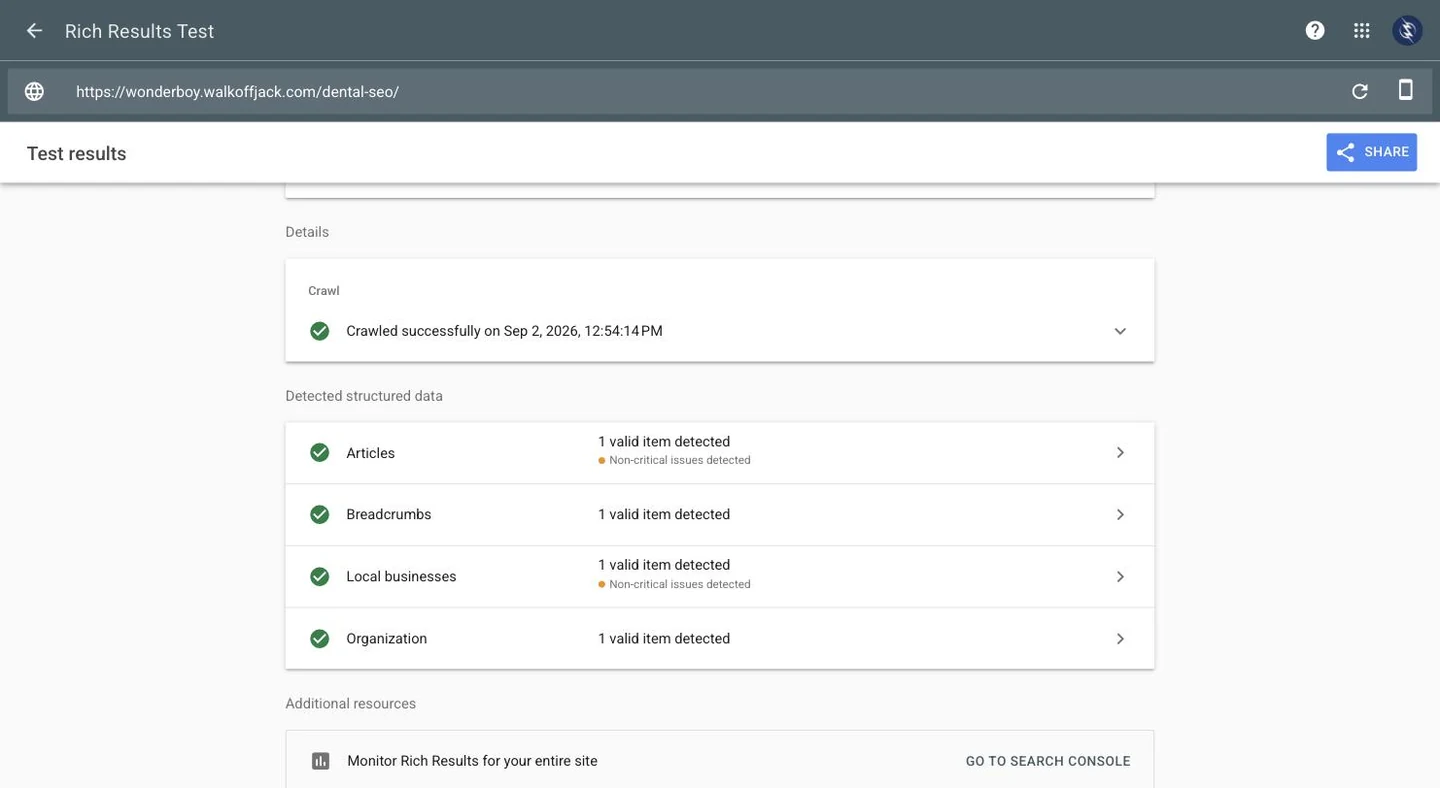
On an invoice it is a build, and the build has a countable number of rows. One block describing the business, carrying the real name, address, phone, hours and category. One block per service page. One per named practitioner, where somebody’s name is the reason customers pick you. Question and answer sections marked as such. Review markup only where the reviews are legitimately yours to publish, which is a narrower set than most plugins assume.
Before any of that goes in, we take out what is already there, and that is usually the larger half of the job. A site that has been alive for six years is typically carrying markup from two or three plugins installed years apart by different people, quietly disagreeing with each other about the business name. Clearing that out has been worth more on plenty of engagements than anything we added afterward – and no proposal ever mentions it, because removal does not photograph well.
It goes into your theme rather than into a plugin, and that is an ownership decision worth understanding before you sign anywhere. Markup that lives in a plugin lives inside a subscription, and it vanishes the month somebody forgets to renew or decides to switch tools. Markup in your theme is a file in your repository, and it is yours the way your logo is yours.
Maintenance on it is close to nothing. Hours change, a service gets added, you move across town. Those are edits measured in minutes and they happen inside the monthly rather than as change requests, because billing a client forty-five dollars to update a phone number is how agencies train people to stop calling them.
The page rewrites, and how we choose which pages
What makes a page quotable is a writing question, and it is answered at length on LLM SEO. What we sell is a specific number of pages, chosen in a specific order, and that is the part worth pinning down before money changes hands.
The list is shorter than most clients expect. Your service pages, the pricing page, the about page, and the handful of articles that already bring in traffic. On a typical small business site that is six to ten pages, and it is the whole of the first-phase rewrite. A site does not need every page rebuilt. It needs the pages somebody would cite to be worth citing.
We pick them from data rather than from taste. Pages that already rank somewhere in the top thirty, pages carrying a service you actually want more of, and pages answering a question we watched an assistant answer badly for your category. Anything failing all three waits its turn.
The rewrite is structural rather than cosmetic. The answer moves to the top of the section, the hedge comes out, a real number goes in where there was an invitation to book a call, and the page stops covering four subjects half way in order to cover one completely. Where that makes the page shorter, it gets shorter, and we do not put the words back to make the deliverable look bigger.
You approve every page before it publishes, in a document with the old version beside the new one, and you can veto a change without justifying it. That has happened. We put the atmosphere back in, the page did fine, and nobody died.
Pages after the first phase get written inside the monthly, at roughly one substantial page or two small ones. Nobody here is generating forty of them. That is a different business model and it is on the list of things we will not do.
The mention work, which is the line item that gets skipped
Why a model wants to hear a claim about you from somebody who is not you is the cleanest mechanism in this subject, and it lives on LLM SEO. Commercially, the thing to know is that this is the slowest and most expensive row on the scope, and it is the row you should check is actually in the contract.
As work it looks like this. We build a list of real, specific places in your category where a business like yours ought to appear and currently does not: the local paper, the trade directories a human still maintains, association and member pages, supplier and partner listings, event programs, the chamber, a podcast that covers your industry. It usually runs between fifteen and forty rows, and every row names an actual place rather than a category of place.
Then the list splits in two, and this is the split worth arguing about at the proposal stage. Some rows we chase ourselves, which means writing to an editor or a directory maintainer and following up twice. Some rows only you can move, because they run on your relationships: the supplier you have bought from for nine years, the winemaker who owes you a favor, the association you are already paying dues to without appearing on. An agency that never hands you that second list is either doing your relationship work badly or quietly not doing this at all.
It is slow. A row that lands in six weeks is fast, six months is normal, and some rows never land because an editor got busy and that was the end of it. We report those too, which makes for a duller monthly than the alternative and a more honest one.
In a town like Walla Walla this is an advantage rather than a chore, because the press is small enough to actually talk to and the wine industry writes about itself constantly. What we are not doing is buying links, running a private blog network, or paying for placement on a site that exists to sell placement. Those are faster and cheaper. They are also why somebody you know is still telling a story about 2019.
Crawler access, and the fifteen minutes that occasionally explains everything
Every one of these companies runs crawlers, your website is either letting them in or shutting them out, and in most cases nobody ever made that choice on purpose. Some businesses have blocked them through a security plugin or a host-level rule or a robots file somebody copied off a forum years ago. Some have blocked them deliberately, which is a legitimate position if you are a publisher whose entire product is the text; if you are a dentist in Richland, it means opting out of being recommended, and almost nobody who has done it meant to.
The wrinkle worth knowing is that the crawler gathering training data and the fetcher reading a page live during an answer are often different agents with different names, so blocking one leaves the other untouched. We check what your site currently does, tell you what each rule is actually doing, and set it to whatever you decide. Fifteen minutes.
What we need from you, and the hours it actually costs you
Every proposal in this category goes quiet about the client’s side of the work, and the client’s side is not nothing.
The first fortnight costs you about three hours. One conversation about what the business really sells and which services you want more of, which happens on the phone and needs no slide deck. Then logins: the website, the Google Business Profile, the domain registrar if anything is moving, and whatever directory accounts you can dig up. Most owners can find about half of them, which is normal, and hunting the rest down is part of what you are paying us for.
After that it is approvals. Six to ten rewritten pages come back in a document and reading them properly takes an evening. Owners who skim and approve everything get a worse page than owners who argue, because you know things about your business that no amount of research surfaces – the job you actually want more of, the customer you would rather never attract again.
Then the relationship rows on the mention list, which are the ones only you can move. Realistically that is four or five emails you send yourself, spread across a quarter. It is the highest-value hour you will spend on any of this and it is the one most likely to sit undone, and we will keep asking about it until it becomes irritating.
If nobody on your side has three hours in the first two weeks and an evening a month after that, the engagement will underperform, and we would rather say that now than explain it to you in month five.
What we hand over in the first ninety days
The first ninety days is a foundation, and it produces objects rather than reports.
A baseline document showing what the assistants currently say about your category and whether you appear in it, with the questions written down so the test can be repeated identically later. A cleaned entity: listings, profile, name, address, categories and description all reconciled, with a record of what was changed and where. A structured data layer built into the site rather than bolted on by a plugin, covering the business, the services and the questions. Rewrites of the pages that carry your money terms.
Then the outreach plan, which is a short list of real, specific places your business ought to be mentioned and is not, with the ones we will handle marked separately from the ones only you can make happen because they involve your relationships.
At the end of ninety days you own all of it – every piece. The schema lives in your theme, the listings are yours, the writing is yours, and if you fire us the following Monday none of it goes away. We build it that way on purpose, and it is why our retention argument has to be that the work is good rather than that we are holding your site hostage.
What you own, and what happens the month you leave
All of it is yours from the day it ships, and that is a contract question rather than a sentiment.
The structured data is a file in your theme. The listings are claimed in your name, under your email address, with the password in your hands. The writing sits on your pages and is not licensed to us. The question log is a document we send you every month rather than a view inside a tool you lose access to. Fire us on a Monday and nothing switches off on Tuesday, and nothing has to be exported before it expires.
This is worth checking everywhere you shop, because the alternative is common and it is rarely said out loud. Schema delivered as a plugin subscription. Listings claimed under the agency’s own email. Answer logs living in a platform seat that is canceled with the retainer. Content published on a subdomain somebody else controls. Every one of those is a hostage arrangement with a friendly name, and every one of them is easier to sell than the version where the client can walk.
The consequence for us is that the retention argument has to be that the work is good. That is roughly the correct amount of pressure to be under.
What the monthly work looks like after that
The monthly is mostly content and mentions, because the foundation only needs building once.
Each month we write, usually one substantial page or two smaller ones, aimed at questions people actually ask rather than at keywords with tidy volume numbers. We re-run the baseline questions and log what changed. We chase whatever mentions are in flight, which is slow and involves a lot of email that goes unanswered. We keep the entity clean as things drift, and things drift constantly, because a staff member updates a profile or a directory rewrites your category or somebody launches a listing site that scraped your details wrong.
Some months the log looks identical to last month’s – word for word. That is a real outcome and we report it as one, rather than inventing motion to justify the invoice.
What we report, and what we refuse to report
You get the question log, the change log and the content log, monthly, in plain language.
The question log is the same set of category questions asked the same way each month, with the answers saved so you can read them yourself rather than trusting our summary. The change log says what we altered on the site and where. The content log says what got written and published.
What we will not give you is a confident number for your AI visibility score, because there is no such measurement and anybody selling one has built an index out of their own assumptions and put a logo on it. Answers vary between users, between phrasings, between days, and sometimes between two identical questions asked ten minutes apart. A number that hides that variance is worse than no number.
The measurement problem is the honest weak spot of this whole service, and it gets a proper explanation on the other page rather than a hand-wave here.
What we will not do
We do not generate a hundred pages of thin content to see what sticks, which is the fastest-growing bad idea in this category and the one most likely to be sold as an AI content engine.
We do not buy links or run private blog networks. We do not add a schema plugin on top of the three you already have. We do not promise placement in any specific answer, because nobody controls that surface and anybody claiming to is describing a coincidence they have decided to take credit for.
We also do not take this engagement for a business whose website is the actual problem. If the site is slow, thin and built on a page builder that emits five hundred kilobytes of markup to render a heading, the AI work is not the intervention that matters. We will say so before you sign, and we will say so plainly enough that it costs us the retainer sometimes.
How to tell a real AI SEO agency from a renamed deck
There are four tells and they are all easy to check in a first call.
Ask them to show you what your category questions currently return. A shop doing the work will have already looked before the call, because it takes four minutes. A shop that has not looked is going to sell you a framework.
Ask what they will change on the site specifically, and listen for whether the answer contains nouns. Schema for services and questions, the listings reconciled, these six pages rewritten – those are nouns. Optimizing your content for AI discoverability is a mood.
Ask who does the mention work and what it looks like, because this is the expensive, slow, human part, and the shops that have quietly dropped it will get vague here.
Ask what they will report and what they will not claim. If a visibility percentage appears on the slide, ask how it is calculated. The answer is usually a weighted average of their own tests, which is fine as a directional signal and dishonest as a metric.
Two more tells live in the paperwork rather than in the call, and they are the ones that cost people money later. Read where the deliverables live. If the schema arrives as a plugin license, the listings get claimed under an address at the agency’s domain, or the reporting exists only inside a seat on their platform, you are renting your own foundation and the rent goes up. Then read the exit clause, or notice that there is not one.
The last check costs you nothing and takes a week. Ask for the name of a client they did this for eighteen months ago and whether that client is still paying them. A shop doing durable work usually has a boring answer to that. A shop selling the renamed deck has churn, and churn is the one number in this industry nobody puts on a slide.
The questions to ask before you sign anything
Five, in order, and write the answers down.
What will you change on my site in the first month, specifically? Who owns the schema, the content and the listings when we stop working together? What does a month look like when nothing improves, and how would I know? How do you measure this, and what are the limits of that measurement? What part of this could I do myself?
That last one is the tell. Everything on this list has a version you could do yourself with enough patience, and an agency that cannot admit which parts those are is protecting a margin rather than advising you.
Where this sits next to your ordinary SEO
This is not a replacement for search work and I would not sell it as a standalone service to most businesses.
Ranking still sends the majority of the qualified traffic that small businesses get, the map pack still decides who gets the phone call, and a business with no search visibility at all is not going to be named by a model either, because the model’s view of your category is downstream of the same web. The two efforts share a foundation – most of one, actually. When we do the entity work, the map pack benefits. When we write a page properly, it ranks and it gets quoted.
If you want the mechanics rather than the service – how models decide which sources to name, why being cited is a different game from ranking, and how anyone measures it honestly – that is the whole subject of our page on LLM SEO. The technical groundwork underneath both is covered in what technical SEO is, and the broader program sits on small business SEO.
Who this is not worth doing for yet
Some businesses should not buy this, and it is a shorter list than you would think but it is real.
If you have no website worth citing, fix that first. If your Google Business Profile has never been claimed, claim it, because the map pack will pay you back faster than any of this. If you are pre-revenue and choosing between this and having a phone answered by a human, answer the phone.
And if your category is one where nobody asks an assistant for a recommendation, this is a slow investment rather than a fast one. Emergency plumbing at eleven at night is still a maps search. Choosing a dentist for a family of four is increasingly not.
How long it takes
Three to four weeks for the foundation, and the honest breakdown is that we are working for about eight days of that and waiting on listing platforms for the rest.
After that, the honest window is the same as the rest of search. Three to six months before anything is visibly different, nine to twelve before it is clearly worth what you paid. Entity and schema fixes can show up faster than content does, and mentions are the slowest of all because they depend on other people’s editorial calendars.
The uncomfortable part is that the feedback loop here is worse than in search, so patience is being asked of you with less evidence than usual. That is the deal, stated as plainly as I can state it. Anybody promising a faster one is promising something they cannot see.
Common questions
What does an AI SEO agency actually do?
It makes your business legible to machines and worth quoting once they find it. In practice that is entity and listing consistency, structured data, page rewrites that answer questions directly, mentions on sites that are not yours, and repeatable measurement of what the assistants say about your category.
Is AI SEO different from regular SEO?
Mostly no, and the honest split is that most of the work is shared and a small slice is genuinely new. The new slice is that answers name very few sources, that what other sites say about you carries more weight than it used to, and that there is no rank tracker to check.
Do I need an AI SEO agency if I already have an SEO company?
Probably not a second vendor, no. Ask your current provider to show you what the assistants say for your category questions and what they have done about entity consistency and schema. If those answers are solid you are already most of the way there.
Can you guarantee my business gets named by ChatGPT or Gemini?
No, and nobody can. The answer surface is not controlled by anyone outside those companies, it varies between users and days, and a guarantee about it is a sales tactic rather than a service level.
Will this hurt my Google rankings?
It should help them. Everything on the list – consistent listings, clean structured data, faster pages, direct answers, real mentions – has been good for search ranking for years, which is the strongest evidence that most of this is not new.
How do you measure whether it worked?
By asking the same category questions the same way each month and logging what came back, and by watching branded search, direct traffic and referrals from the assistants where they are attributable. It is a weaker measurement than rank tracking and we say so rather than dressing it up.
Do you work with businesses outside Walla Walla?
Yes. We work with clients across the Walla Walla Valley and the Tri-Cities, and with clients nowhere near either, and none of this work depends on being in the same town. The mention half goes faster when we know the local press, which is an argument for hiring somebody local to you rather than somebody local to us.