






The three small business SEO packages, and who each one is for
Almost every page selling small business SEO packages says pricing depends, then asks you to book a call to find out what it depends on.
That is the whole menu. There is no fourth tier where you get the good stuff.
Foundation, and why it is a one-time job
We rebuild the Google Business Profile from the category up, clean the citations, install local business schema, fix the heading structure and the speed problems on the pages you already have, and set up a review request system that somebody in your shop can actually run. Then we hand it to you with a document and a walkthrough, and you owe us nothing further.
Most agencies will not sell this, because a finished job does not renew. We sell it because a lot of small businesses genuinely do not need a monthly retainer, and telling somebody they need one when they do not is the reason this industry has the reputation it has. If you are the only upholsterer in a town of forty thousand, you need your profile fixed once and then to go back to work.
The honest limit of Foundation is that it does not compound. It removes the obvious problems and lifts you to wherever your existing pages can carry you, and that is a ceiling rather than a slope. If your competitors are publishing and you are not, the gap starts widening again in month three.
Foundation is also the package we most often talk people into. Somebody arrives asking for a monthly retainer because a cold email told them they needed one, and the profile turns out to have the wrong primary category and a phone number from two moves ago. Fix that first. Spend the monthly money later, if the numbers say to.
Local, which is the one most small businesses actually need
Everything in Foundation happens in the first month, and then the monthly work begins: pages get written, the profile gets touched, reviews keep arriving, and the internal linking gets rebuilt as the site grows. The difference between the bottom and the top of that range is almost entirely how many pages get written, because after the foundation is finished, content is the only thing left that compounds.
What a month looks like is a good deal less glamorous than the word strategy suggests. Somebody writes a real page about one thing you do, somebody checks the grid, somebody answers the two questions that appeared on your profile, somebody drafts replies to the four new reviews, and somebody fixes whatever broke. Multiply that by nine months and the phone rings differently. No single month in there would impress anybody.
The other thing Local buys you is somebody noticing. Google changes the profile interface, a competitor changes their primary category, a plugin update breaks the schema, a review lands that needs answering the same day – none of that is strategy and all of it costs you money when nobody is watching.
Competitive, for markets that do not forgive
The work is the same shape and there is more of it, run against more surface area. Three to six pages a month instead of one to three. Grid tracking at every location rather than one – the single measurement that works for one shop tells you nothing about four. Entity and AI visibility worked actively rather than watched, because in a crowded category the question of whether a model names you when somebody asks it for a recommendation has stopped being theoretical. Our AI and LLM work sits inside this tier rather than being sold as a separate product with its own invoice.
If you are a single-location business in a town this size and somebody is quoting you five thousand a month, ask them what specifically is being done with the fourth thousand. It is a fair question – and in our experience it usually does not have an answer.
We will also talk you out of this tier, which is not a sales technique so much as self-interest, because a client paying for scope they do not need leaves in month six and tells people we were expensive.
How we decide which package to quote you
Before quoting anything we look at four things, and all four are visible from outside without you sending us a single password.
We look at the Google Business Profile and what its primary category is, because that single field decides which race you are entered in. We look at the site: how many real service pages exist, how fast it loads on a phone, and whether the heading structure is a structure or a pile. We run one grid measurement for your main service so there is a before, and then we look at who currently holds the three map pack slots and what they have been doing lately.
That takes about an hour – and it tells us a great deal more than an hour of discovery call would. If the answer is that you need Foundation and nothing else, we say Foundation. If the answer is that your site is the actual bottleneck, we say that too, and then nobody sells you a retainer that month. The hub page covers how the whole silo fits together if you want the wider view first.
What is not in any of these SEO packages for small business
Three things get left out on purpose, and leaving them out is what keeps the monthly numbers honest.
Neither is anything that requires lying. No bought links, no fake reviews, no keyword-stuffed business name, no dozen location pages for towns you have never worked in. Those tactics all still work a little, right up until the week they do not.
What actually moves the number
Inside each range, four things decide where you land, and none of them is how much we think you can pay.
The first is how many locations and service areas you have, because every one of them is another profile, another grid, another set of citations. The second is how many services you want pages for, which is the real content cost. The third is the shape of the site you already have; a clean hand-built site takes less monthly technical work than a nine-year-old theme with four page builders stacked on it. The fourth is how competitive the category is, and dentistry is not upholstery – the top three in a dental market defend their slots with real money, and the top three in upholstery mostly are not looking.
What does not change the price is your revenue. We have watched agencies quote a percentage of what they think a lead is worth to you, which is a defensible pricing theory and a terrible way to be treated. The work costs what the work costs. Your margin is your business. How much SEO costs goes into the general shape of that question across the whole market.
What we will not do at any scope
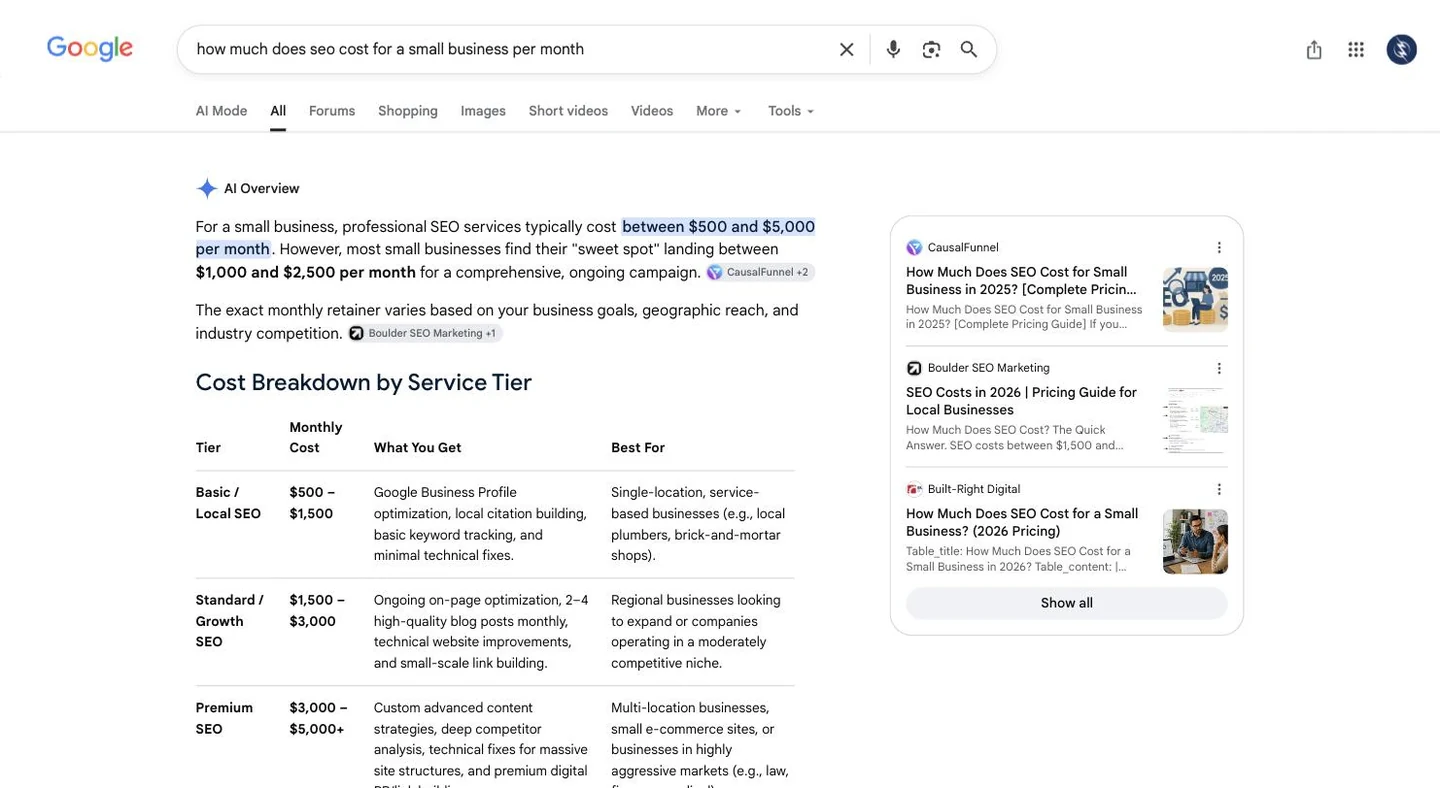
The one number people ask for that we do not have is a cheaper tier. Below about a thousand a month there is not enough time in the month to write anything real, and a retainer that buys four hours produces four hours of work dressed up as a report. That is not a bargain. If that is where your budget is, read affordable SEO services, an honest page about what a small budget buys and what it cannot.
We also do not do the three-month trial that ends right before the work would have started paying. Three months is the part of the graph where nothing has happened yet; quitting there is the most expensive thing a small business can do in SEO, because it pays for the whole cost and collects none of the return.
How long it takes before any of it moves
Profile work moves first, sometimes within the first few weeks, because a wrong primary category is a fixable problem rather than a slow one.
Citation corrections and a steady arrival of reviews register somewhere inside the first three months, which is faster than the content and slower than the profile. Website content takes three to six months to become visible in the blue links and nine to twelve to be worth what you paid for it. That is not hedging, it is the actual shape of the curve, and any package sold with a thirty-day promise attached is either aimed at a keyword nobody types or is about to do something that has to be undone later.
The part nobody warns you about is month four, where the line on the chart looks flat and you start wondering whether you have been had. Month four is normal. It is also where most of the people who quit, quit.
Common questions
Do I have to sign a contract?
No. Everything monthly is month to month, and the one-time package is finished when it is finished. We would rather you stay because the work is working.
Which package should I start with?
Most single-location businesses in a small market should start with Foundation and see what it does before committing to anything monthly. If you already know you want new pages every month, start with Local, because Foundation is the first month of it anyway.
Can I upgrade or downgrade later?
Yes, at any month boundary. Moving from Local up to Competitive usually happens when a second location opens; moving down usually happens when the pages are written and the maintenance is all that is left.
What happens if I cancel?
The site, the pages, the profile, the schema and the tracking are yours and they stay where they are. Nothing is held in an account we control, and nothing switches off. Rankings do not vanish the month you stop. They stop improving.
Do you work with businesses outside Walla Walla?
Yes. We work with clients across the Walla Walla Valley and the Tri-Cities, in Kennewick, Richland and Pasco, and with clients nowhere near either, and the method travels fine. Local knowledge helps with the content and does nothing at all for the algorithm.
Is a cheap SEO package ever worth it?
Sometimes, if it is genuinely small in scope and honest about that. A three hundred dollar package that claims to do everything is not small in scope, it is small in truth, and how to choose an SEO agency covers how to tell the difference before you sign.
What if my website is the actual problem?
Then we say so before taking the SEO money, and that conversation happens more often than you would think. A retainer pointed at a site that cannot hold a visitor is rent paid on a problem the retainer is not allowed to fix.