






Three slots, ten links, and one paragraph
Type your own trade and your own town into Google, standing in your own shop, on your own phone. That screen is the job.
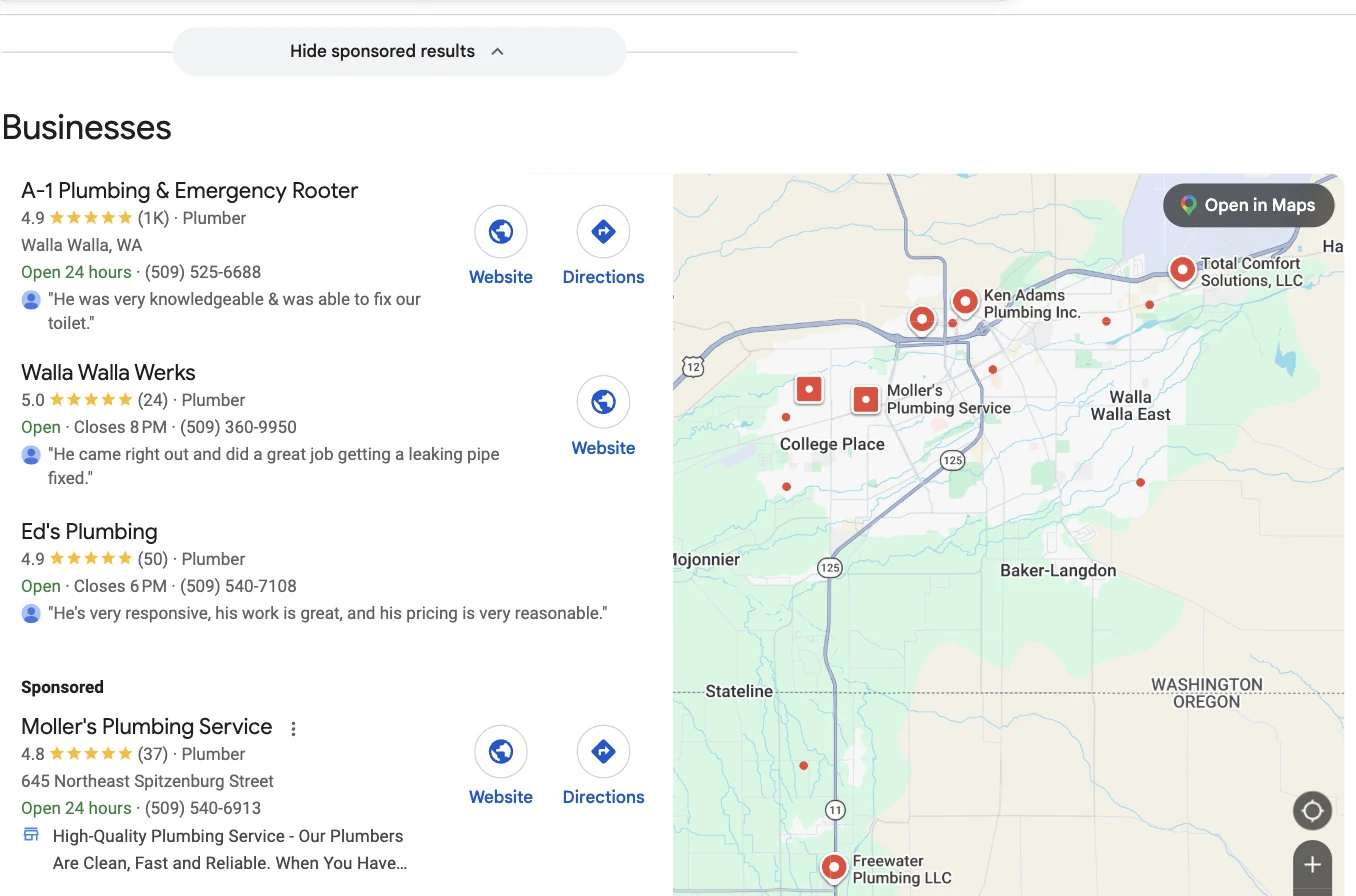
Small business SEO services exist to get you onto it, and an honest description of the work starts by admitting how little of that screen is for sale. Three slots carry a map. Ten blue links sit underneath. Above both of them a paragraph now names two businesses and then stops. In every category in every town a handful of businesses take most of the calls – and everybody else finds out at the end of the month, when the phone rang the way it always does and no new work arrived.
We are Wonderboy Creative, a web design and SEO shop in Walla Walla, Washington, working across the valley and out into the Tri-Cities. Our Domain Rating is 32, which is low, and we would rather print that on our own hub page than have you find it in a tool an hour after the call. We hand-build WordPress sites without page builders, we do the search work on top of them, and we tell clients when the website is the actual bottleneck rather than the SEO. That conversation costs us money about once a month.
Everything we sell sits on this page. What the work is, which parts move in a fortnight and which parts take a year, and what every piece of it costs in dollars. Then where the six deeper pages live when you want one subject taken apart properly. It runs long because there is a lot of it, and because the alternative is a page that says we deliver customized strategies and asks you to book a call.
Google shows a small business three different competitions on one screen, and most owners have never had them separated out.
The map pack is the first, and it is three results with a map attached. It runs on your Google Business Profile, on how close you are to the person holding the phone, and on what your reviews say and how recently they said it. Your website barely touches it directly. The blue links underneath are the second competition, and that one runs almost entirely on your site. How many real pages you have, how fast they load, how well they answer the question somebody typed, and who links to you. A business can hold first place in the pack while its website is invisible six inches lower down the screen, and we have watched that happen more than once.
The third is newer and it behaves differently from both. An AI answer, whether at the top of the results or inside an assistant somebody opened on purpose, names a few sources and then stops. There is no fourth position in a paragraph. You are named or you are not, and the businesses that get named tend to get named again, because whatever convinced the model the first time is still sitting there the next time somebody asks.
Three surfaces, three sets of rules, one invoice. Most agencies sell the work for one of them and call the whole thing SEO, and the tell is which one they show you first. The map pack pays fastest and has the lowest ceiling; the blue links pay slowest and compound. The answer surface is cheap to work on if you are already doing the other two properly, and close to unreachable if you are not. Nobody separates them for you.
Where most small business SEO services go wrong
The core problem with small business SEO services is not that agencies are lazy or dishonest, though some are both. It is that the business model wants a subscription and a lot of the work is a finished job.
Fixing a Google Business Profile is a finished job. Cleaning up the six directories that still carry your old suite number is a finished job – and it stays finished until you move. Installing schema properly, once, in the theme rather than through a plugin, is a finished job. None of those renew, and an agency whose rent depends on renewals has a quiet incentive to describe them as ongoing programs with monthly reporting. We have read proposals selling monthly citation management to a business that had been at the same address for eleven years. That is a subscription to a completed task.
The second failure is arithmetic. An SEO retainer is mostly somebody’s hours – and the software in it is not the expensive part. Three hundred dollars a month, at any wage a competent person accepts, is somewhere between two and four hours of somebody’s attention. Two hours is a plugin update and a status email. It is not a page, it is not a technical audit, and it is certainly not the eleven deliverables printed on the proposal. It buys almost nothing. So the money buys automation wearing a person’s name, or it buys a very thin slice of somebody carrying ninety other accounts.
The third failure is the expensive one, and it is quitting in month four. The graph is flat in month four for everybody, including the engagements that go on to work, and month four is where the people who quit tend to quit, in the engagements we have watched from the outside and the ones we have run ourselves. They pay for the entire cost of the thing and collect none of the return. Do not quit there.
We build the websites too, which changes what we sell you
Most SEO agencies cannot touch your website, so every problem they find has to be solved with content and links – which is a narrow set of tools for a wide set of problems.
We build sites, which means we are allowed to say the unpopular thing: quite often the search work is not the intervention that matters. Take a site that loads in nine seconds on a phone with two bars on Highway 12, that lists nine services on one page, and that emits half a megabyte of markup to render a heading because a page builder generates it at runtime. No retainer rescues that. Pointing traffic at it is an expensive way to prove the site is slow.
The upside for a client is that the SEO gets cheaper afterwards. A hand-built site with clean headings and correct schema needs less monthly work than a nine-year-old theme with four page builders stacked on it. More of the retainer goes to writing pages instead of undoing things. The wider case for that argument sits on web design, and the local version of it is on Walla Walla web design.
What a small business SEO company should tell you before it takes your money
Four things, and any shop worth hiring hands all four over in a first conversation without needing a week to prepare them.
A specific list of what changes in month one. Not an approach and not a philosophy – a list with nouns in it. The primary category moved from this to that. These six pages rewritten. The listings on these eleven directories reconciled. Schema installed for the services and the questions. If what comes back is about optimizing your presence, you have been handed a mood instead of a plan, and a mood cannot appear in a report at the end of the month.
Who holds the keys at the end. The pages, the profile, the schema, the tracking and the code all belong in accounts with your name on them rather than inside a platform that goes dark the month you stop paying. Ours are. The direct consequence is that we have to keep clients by being useful to them, which is roughly the correct amount of pressure for an agency to be under.
What a bad month looks like, and how you would find out it was one. Real search work has months where the honest report is that nothing measurable moved. A shop that has never had one of those has been writing fiction, and you are going to be reading it for a year.
And the one that tells you the most about who you are talking to: which parts of this you could do yourself. Nearly everything here has an amateur version that works if you have the patience for it, and a shop unwilling to name those parts is guarding a margin instead of giving you advice.
Local SEO for small business, the piece the other five reuse
Start with a heating and cooling company working out past College Place, twelve years old, good at the job, quiet phone.
Somebody sells them four blog posts a month, which is the easiest thing in this trade to sell and the slowest thing in it to pay. Twelve posts later nothing has moved, and the reason sits in a form field nobody opened – the profile says Contractor where it ought to say HVAC Contractor, so the searches that would have produced calls were ones this business was never eligible for. The posts were not bad writing. They were pointed at a competition the company had not entered.
Nothing about that failed loudly. The posts published on schedule, the report arrived on the first of the month, and the card cleared every time.
Local SEO goes first because the other five pieces on this page are assembled out of what it leaves behind, and because the wrong order never announces itself. Look at what a finished local pass hands you, counted as objects rather than as activity. One spelling of your business name, one address and one phone number, sitting identically in every place a machine is likely to read them. One primary category, chosen on purpose rather than clicked in a hurry by whoever filled in the form. A layer of local business schema living in the theme, where no plugin subscription can take it away. A real page for each service you sell instead of a list of nine of them. And a review request that somebody at your counter makes without being reminded, because it is written into how a job ends.
Five objects – and every one of them turns up again as a billable row on the maps work, on the AI foundation and on the monthly writing program, which means the order you buy in quietly decides how many times you pay for the same thing.
The rule underneath it is dull enough to fit on an index card. Buy the pieces that produce objects before the pieces that produce activity; an object can be checked afterwards by somebody who did not do the work, and activity has to be taken on trust every month for a year.
What the profile work contains field by field, how a review system gets built so that it survives a busy Saturday, and why the ranking you see standing in your own parking lot is close to meaningless, are on local SEO for small business.
Google Maps SEO, and why the map sets your budget
Count the centers of gravity in your market before you read anybody’s proposal. That number should move a local search quote more than your category does, and a great deal more than anybody’s guess at what you can afford.
Walla Walla has one. A pin near Main Street reaches most of the people who would realistically drive to you, and College Place three miles west and Milton-Freewater twelve miles south sit inside a pattern one well-run listing can mostly cover. The Tri-Cities does not work that way at all. Kennewick, Richland and Pasco are three centers with a river folded through the middle of them, and a business holding a strong position in one of the three holds nothing in the other two. Same work, same competence, three times the surface to hold.
The trap is trying to solve geography with optimization, and almost every business in a spread-out market tries it at least once. Drawing a service area across four counties. Adding town names to page titles. Renting a mailbox in the town you would rather rank in, which is a fake return address and gets treated as one the week a competitor reports it. None of that moves a pin, because Google measures from a point it has verified and the point is indifferent to whatever you have drawn around it.
The two things that do move it cost money and neither one is SEO – a second staffed location, or a crew and a fleet visible enough in the second town that people there start saying your name. We put it in the quote, in writing, which is a strange thing to volunteer.
Then there is the part nobody plans for. Map work has a hard ceiling and you arrive at it early. The profile comes right, the categories come right, the reviews start arriving, and then the surface stops moving no matter what gets spent on it. The correct response is to shrink the map line on your invoice and grow the writing line, deliberately, around month five or six. Most programs never make that handover, so a business ends up in year three paying a monthly aimed at a surface that stopped changing in its first summer. Nobody flags it.
How the ranking is computed, what the pack radius does in dense and in empty places, how to measure a rank that changes every hundred yards, and what to do about the competitor who has stuffed three keywords into their business name, are on Google Maps SEO.
AI SEO agency work, and how to price the increment
Nobody buying this needs convincing that the answer surface matters. So here is how to check an AI quote in about twenty minutes, using nothing but the quote and your own phone.
First, ask the shop what they would charge for ordinary search work on the same site, with none of the new vocabulary in it. Second, subtract that number from the AI number. What is left is the price of the genuinely new part plus whatever the label costs.
Third, ask what the genuinely new part contains, and write the list down as they say it. It is short. A decision about which crawlers your site lets through, which takes a quarter of an hour and which almost nobody has made on purpose. A set of category questions asked in the assistants on a schedule, with the answers kept where you can read them. A push to get your business described accurately somewhere you do not own. Priced honestly that is an increment. An increment arriving as a second full program is a second full program with one afternoon of new work inside it.
Fourth, check the four conditions that have to be true before a dollar spent on AI visibility does anything at all. Your business resolves to one name, one address and one category wherever a machine looks. Your site is quick and reachable. Real pages carry the services you actually want more of. Somebody who does not work for you has described your business somewhere. Three of those four are the chapters above this one.
Fifth, ask which of the four are true on your site today, because that is the step that ends most of these conversations. What we see about monthly is the reverse of all of it: a business whose Google Business Profile has never been claimed, on a site that takes six seconds to show anything on a phone, being offered a monthly AI visibility program by somebody who found them through a contact form. That is selling the last tenth of a job and starting the invoice there.
What the service contains, what lands in your hands in the first ninety days, and the tells that separate somebody doing the work from somebody who retitled a deck last spring, are on AI SEO agency.
LLM SEO, and the one thing it changes about the order
You can accept every claim being made about AI answers and still change almost nothing about what you buy. Almost. There is exactly one reordering, and the mention work is it. For twenty years, being written about somewhere you do not control was the last line a small business bought, filed under public relations and dropped in the third month of every budget; it now belongs ahead of the blog, ahead of the fourth and fifth service pages, and well ahead of anything anybody wants to call a strategy. A machine writing three sentences names the businesses it is confident about, and its confidence is built out of hearing the same plain description of you from people who have nothing to do with you. Your own website is a single voice with an obvious stake in the answer. A distributor’s dealer locator, a trade association directory, the county fair program you already sponsor, a paragraph in the local paper – the second and third voice are worth more to you than the fourth page you were planning to write.
That is a purchasing consequence rather than a theory, so here is what it costs you. Mention work is the slowest row in this entire program and the one most likely to be dropped quietly, because a row that lands in six weeks is fast and six months is ordinary. Half of it is not ours to do, either; the chamber, the supplier you have bought from for nine years and the association taking your dues without listing you anywhere all move when you send the email rather than when we send it, and four or five emails a quarter from your side is the realistic ask. There is no position to track inside an answer, no chart, and no honest single number to put at the top of a report, so we keep this line small enough that being wrong about it costs you very little. One line, not the headline. An industry that cannot measure something has every incentive in the world to charge confidently for it.
How a model arrives at the handful of sources it names, where an answer gets its facts, what makes a page worth quoting, why corroboration works the way it does, and what an honest measurement setup looks like when there is no rank tracker, are on LLM SEO.
Small business SEO packages, and the question they are actually answering
Does anything on your side keep changing? That question settles more about which package fits you than any comparison table will, and it is almost never asked in a sales call.
Now hold that number against your own business, which is the step nobody takes in the room. Do you have twelve to thirty-six things genuinely worth a page? A shop with six services and two towns it works in has maybe ten, written properly, and after those ten the writer is padding to fill an invoice. That is the month a program should shrink or end, it arrives on a calendar date, and hardly anybody mentions it on the way in. We would rather say it here than in month fourteen, four months and six thousand dollars after the list ran out.
The direction of travel is the other thing to settle in advance. Over three years a healthy engagement should get smaller rather than larger. Year one is the foundation and the first real pages, year two is the rest of the pages and the mention work, and by year three the list of things worth writing has run out and what is left is maintenance and measurement. A proposal describing year three as costing more than year one is describing an agency’s revenue plan – not your business.
The tier we recommend most often to a single-location business in a market this size is the one-time foundation and nothing after it, which ends with us handing over a document and going quiet. That is not generosity. Selling somebody a retainer they did not need buys eleven months of revenue and a person who tells the story at barbecues for a decade.
Every row of all three packages side by side, what each tier does in a given month, and the three things left out of all of them on purpose, are on small business SEO packages.
Affordable SEO for small business, where the order matters more than the amount
Multiply whatever monthly number you have been quoted by twelve before you agree to anything. It takes about a minute and it settles most of these decisions.
We publish the floor rather than negotiate around it, and the floor is a thousand a month. We are not defending our own pricing with that. It is arithmetic about hours, run at a different number.
So when the money is tight, buy a shorter list rather than a cheaper monthly. Take the pieces on this page that finish, buy them one at a time in the order given here, and let the calendar stretch. None of it decays while the next payment is being saved for. That is the quiet advantage of a program built out of finished jobs rather than a subscription.
Small budgets get wrecked by being spent monthly and by being spent out of order, which manages to be cheap and wasted at the same time. That is the failure we inherit most often. Somebody buys content while the primary category is wrong. Somebody buys AI visibility while their address reads three different ways across the internet. Somebody buys links while the site takes six seconds to show anything on a phone. In each case the money was real and the sequence was backwards, and what the owner takes away from it is that search does not work for businesses like theirs. That conclusion costs more than the money did, and it lasts longer.
There is also a version of the first two pieces you can do yourself for nothing, and we would rather hand it over than sell around it. It runs to about five items and a couple of weekends of evenings. The first item on it is opening your Google Business Profile and checking the primary category against the three businesses currently sitting in the pack, which is what we would do ourselves with one hour and no budget.
What a small budget genuinely buys, what it cannot buy at any discount, what to cut first when something has to go, the free list in full, and the cheap tactics that create a bill you pay years afterwards, are on affordable SEO services.
How the work is scoped
Here is the whole of what we sell, in one place, ready to sit beside whatever else is on your desk.
The one thing that never enters the calculation is how much money you make. Value-based pricing, where the quote is a share of what somebody has decided a new customer is worth to you, is coherent as a theory and unpleasant to be on the end of, and it means two identical jobs get two different invoices for reasons the cheaper client never learns. We price the hours. What you earn on the other side of them is nobody’s business but yours.
Nothing we sell sits at the very bottom of the market, and we are not going to build a smaller tier to win an argument about budget. If that puts us out of your range, the free list on the affordable SEO page is what we would tell a friend.
How the work actually goes, month by month
Everything starts with the same four-week foundation, whichever package you end up on, because there is no version where we skip it and start writing.
Week one is measurement and access. One grid rank measurement for your main service so there is a before that nobody can argue with later, a crawl of the site, a look at the profile and the directories, and the same ten category questions run through the assistants and saved word for word. Weeks two and three are the fixes: primary category, services, hours, photos, citations, schema, heading structure, the speed problems that are fixable without a rebuild. Week four is handover – a document listing what changed and where, plus a walkthrough with an actual human being.
If you stop there, you have bought the foundation and we are done. If you continue, the month is a page, a measurement, and a list of small things that went wrong while nobody was looking: a plugin update that took the schema down at two in the morning, a review that wanted answering the same day, a question posted on the profile by somebody choosing between you and a competitor. None of that is strategy. It is the reason a site nobody watches gets quietly worse.
Nine of those months in a row is what changes the phone, and not one of them would survive being described at a dinner party. That is the honest problem with reporting on this work, and it is why what arrives on the first of the month is a change log, a content log and a question log in plain language rather than a dashboard carrying a score. Some months the log reads almost identically to the last one. We report that as the outcome it is.
How long it takes
Profile and category work is the fastest thing in search. When a primary category was wrong, two to four weeks is a normal window for something visible to happen, and that one result flatters this trade more than anything else in it does.
Citation clean-up and review velocity show up across one to three months; the clock is slower than the profile work and faster than everything else. Content is the slow half. Three to six months before it shows up in the blue links, and nine to twelve before the arithmetic clearly favors you. AI and entity work runs on roughly the same clock with a weaker feedback loop attached, because there is no rank chart to look at while you wait. Google Ads, if you run them alongside, produce usable data in four to six weeks, which is a different clock entirely and the main reason we keep the two invoices separate.
Then there is month four. Month four is flat, the graph looks like nothing is happening, and you will start wondering whether you have been had. Month four is normal. It is also where people quit, and in our reckoning that is the most expensive decision on offer in this whole subject, because it pays the entire cost and collects none of the return. We would rather tell you that in August than in the following March.
What you own if you fire us
Everything. The site, the code, the content, the pages, the profile, the schema, the tracking and the domain are yours and they sit in accounts with your name on them.
None of it is parked in a platform we control, so there is nothing for us to switch off when an invoice stops. Leaving does not delete a ranking. It stops the part that was still adding to it, and the decline is slow enough that most owners misread it as nothing happening at all. We build it this way deliberately, and the deliberate consequence is that we have no way to keep a client except by being worth keeping.
What we will not do
No bought links, no private blog networks, and no link packages, because links from a network are the one cheap tactic with a real downside attached and the cleanup costs more than the links did.
No fake reviews and no review gating, which means no screening happy customers toward Google and unhappy ones toward a private form. No keywords stuffed into your business name, which works right up until the suspension, and reinstatement runs through a form with no phone number attached to it. No template location pages for towns you have never worked in. No hundred pages of thin generated content to see what sticks, which is the bad idea we get asked about most often now. And no promise that you will turn up in any particular AI answer, since that surface belongs to companies none of us has leverage over, and a guarantee about it is a coincidence somebody has decided to take credit for in advance.
We also turn down the engagement when the website is the actual bottleneck. The place to say that is before anybody signs anything, in a sentence short enough that it cannot be misheard, and it has cost us the retainer more than once.
Who this is not for yet
Four kinds of business should not buy search work this quarter, and none of the four is unusual.
An unclaimed Google Business Profile is the first case, and the fix is an hour of your own afternoon rather than anybody’s retainer. A site nobody would stay on is the second, and eight weeks of building beats eight months of pointing traffic at it. A business still deciding whether it has a business is the third, and the money belongs in whatever answers the phone. The fourth is the hardest to say out loud: an average of two stars, earned, described accurately by the people who left them. Ranking is not that business’s problem, and lifting it would only widen the audience for the problem it does have.
Where SEO for small business sits next to everything else
Search work does not stand on its own, and the shape of a good program depends on what kind of business is buying it.
If the website is the piece that has to happen first, web design covers how we build, and Walla Walla web design covers what it means to hire somebody who lives here, drives the same roads and already knows which local publications answer their email. There is nothing sentimental in that. The mention work that feeds both AI visibility and ordinary authority runs on local relationships, and it goes considerably faster when somebody already has them.
Common questions
How long does SEO take to work for a small business?
Profile and category fixes can move in two to four weeks. Content and authority take three to six months to become visible and nine to twelve months to be clearly worth what you paid, and month four looks flat for everybody, including the engagements that end up working.
Do I need SEO if I already rank in the map pack?
Probably, because the map pack is three slots and the blue links underneath it are a separate competition running on your website. Businesses that hold a map slot and have no website visibility are one competitor away from losing both, and they usually have no idea how thin the position is. Three slots is not security.
Can I do small business SEO myself?
The profile work, the review requests and the directory clean-up, yes, and you should if money is tight. Writing and the technical side are the parts that break when they are done part-time, because both want a steady rhythm and what a busy owner has is an occasional free week.
Is SEO or Google Ads better for a small business?
They answer different questions. Four to six weeks of ad spend will tell you what people search and what they do when they land, and the moment the card stops, so does the phone. SEO takes months to arrive and then keeps arriving. Run ads if this quarter has to work; do the SEO if next year has to. The common mistake is funding both at half strength and getting neither.
What makes a good small business SEO company?
One that answers in nouns, prints its prices, hands you everything you paid for if you leave, and can tell you which parts of the job you could do yourself. Ask what a month looks like when nothing improved, and listen for whether they have ever had one.
Do you work outside Walla Walla?
Yes, and nothing in the method changes with the map. What changes is the mention work, which runs on knowing which editor answers email and which association actually maintains its directory, so hiring somebody local to you beats hiring somebody local to us on that one row and matters on none of the others.
Does AI search mean SEO is finished?
No, and mostly the opposite. The same work that gets you named in an answer – consistent listings, clean structured data, pages that state things plainly, mentions on sites that are not yours – has been good for ranking for years. A business with no search visibility does not get named by a model either, because the model’s view of your category comes off the same web.